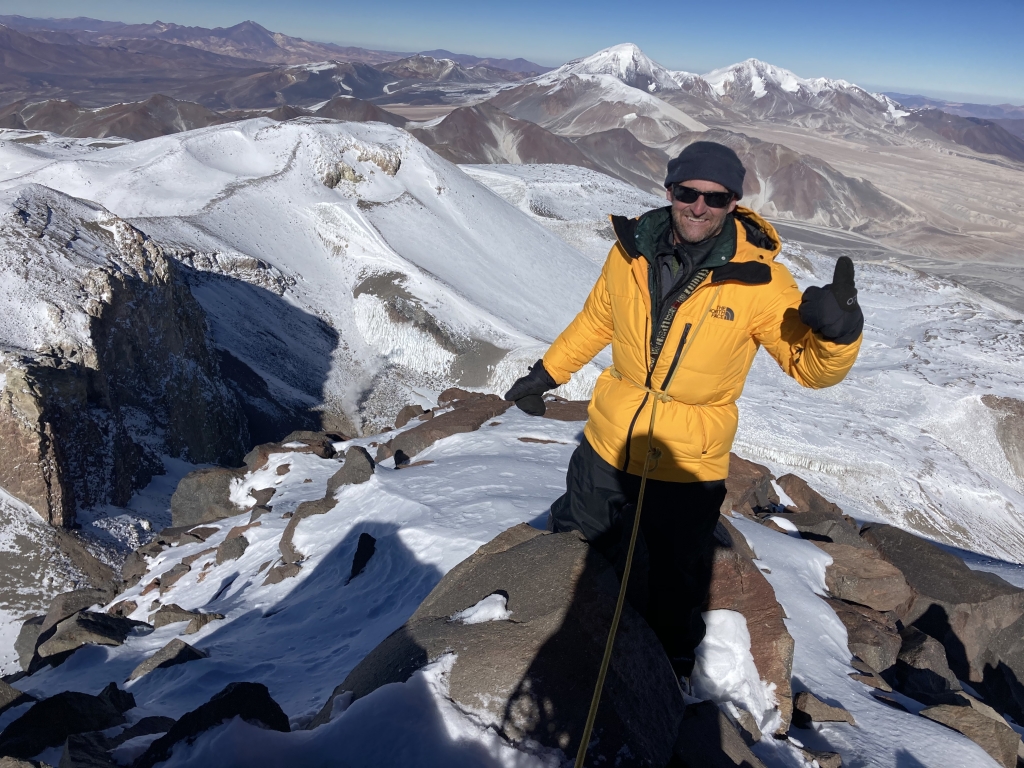
Some of the mightiest mice in the world live in the high Andes mountains at heights once thought to be uninhabitable by mammals. University of Nebraska–Lincoln biologist Jay Storz is trying to determine how they do it.
Storz, George Holmes Professor in the School of Biological Sciences, will present the next Nebraska Lecture at 3:30 p.m. Oct. 6 in the Nebraska Union’s Swanson Auditorium.
The title of Storz’s talk is “Life Ascending: Extreme Animals and Exploration in the High Andes.” A live webstream will be available on the Nebraska Lectures website.
In May, Storz received a Fulbright Scholar Award — his second — to collaborate with researchers in Argentina on how animals adapt to extreme environments, particularly low-oxygen conditions at high elevations in the Andes, the world’s largest continental mountain range.
His research centers on Andean mice that live on the upper reaches of volcanoes at elevations above 22,000 feet. At such elevations, oxygen levels are less than half those at sea level.
Storz said his team is conducting fieldwork that involves a combination of mountain climbing and zoological surveys in extremely remote regions of the Central Andes previously unexplored by biologists.
“Such elevations were previously thought to be completely uninhabitable,” Storz said. Ongoing genomic and physiological experiments are revealing the adaptive mechanisms that enable the high-elevation mice to survive in such hostile conditions.
“Basically, we’re trying to understand how animals are able to cope with oxygen deprivation at the limits of where mammals can live.”
Storz’s team combines complementary expertise — evolutionary genetics and physiology — to get at these answers.
Storz long has collaborated with scientists across South America, and has partnerships with research institutes in Argentina, Chile, Bolivia, and Peru. He has an especially strong affiliation with the Instituto Argentino de Investigaciones de Zonas Áridas, a national research institute in Mendoza, Argentina.
Storz’s lecture also will cover indigenous Andean cultures, from the time of the Incan Empire to the present, and their relationship to sacred Andean peaks.
The National Science Foundation and the National Institutes of Health have provided support for Storz’s research.
Storz received his bachelor’s degree in biology at the University of Colorado; his Ph.D. in biology from Boston University and completed postdoctoral work at Duke University and the University of Arizona. He’s been at UNL since 2005. In 2025, he earned the University of Nebraska’s system-wide President’s Excellence Award for Research and Creative Activity.
Storz’s lecture marks the final presentation in the long-running lecture series, which has featured high-profile presentations by distinguished Husker faculty who address topics of broad interest in an engaging, accessible format. Archived videos from each lecture are available on the event website.
The Nebraska Lectures: The Chancellor’s Distinguished Speaker Series is sponsored by the Research Council, Office of the Chancellor, Office of Research and Innovation and Osher Lifelong Learning Institute.
With the Nebraska Lecture series being sunset, R&I is exploring new ways to engage the broader community in learning about groundbreaking research happening at UNL. More information will be forthcoming.