Tiffany Lee, September 25, 2026
Husker researchers make discovery in material that powers modern electronics

A Husker research team’s latest milestone could open the door to broader use of a class of materials whose electrical properties may someday power next-generation electronics, high-density energy storage, improved computer memory and new strategies for cooling.
In a new paper published in Science, Nebraska physicists Xiaoshan Xu, Alexei Gruverman and Evgeny Tsymbal demonstrated that hafnium oxide – a tough, heat-resistant chemical compound used widely in modern electronics – is inherently antiferroelectric, a rare quality found in very few materials. Unlike hafnium oxide, also known as hafnia, many antiferroelectric materials contain the toxin lead, which limits their widespread use.
The trio said the groundbreaking discovery will help settle a longstanding debate in the field about hafnia’s properties. Though scientists have long predicted the material’s antiferroelectric behavior, and observed electrical signatures consistent with that behavior, definitive experimental evidence connecting the material’s atomic structure with its electrical response has remained elusive.

“The paper is very exciting,” said lead author Xiaoshan Xu, Susan J. Rosowski Professor of physics and astronomy. “Not only have we discovered this new material with inherent antiferroelectricity, but the material is compatible with the modern electronics we already have, including our cell phones and computers. That sets it apart from all the other materials that have ferroelectricity and antiferroelectricity.”
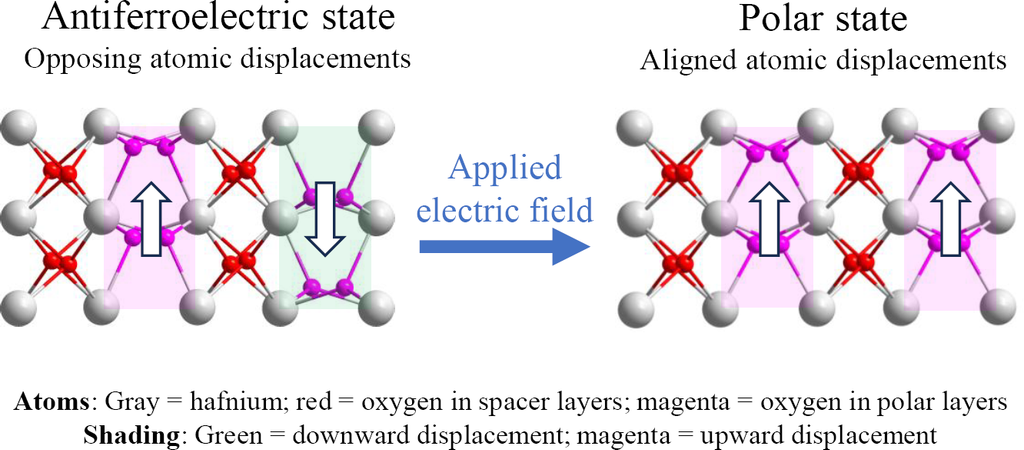
The paper goes a step further, suggesting that hafnia might serve as a prototype antiferroelectric, meaning it can represent the class of materials for teaching and research purposes. This is because its composition squarely aligns with the classical definition of antiferroelectricity: neighboring polar layers have atomic displacements pointing in opposite directions and are separated by nonpolar spacer layers.
Antiferroelectricity: A “switch” for future technologies
An antiferroelectric material has two groups of electrical dipoles that naturally point in opposite directions, canceling each other out and leaving the material with no overall electric polarization. When an external voltage is applied, it acts as a switch, changing the material from electrically neutral to polarized until the voltage is removed. This “switchability” is valuable because it enables the material to take in and release energy, change temperature and store information.
An atomic-resolution electron microscopy image of lanthanum-doped hafnia. The colored arrows indicate tiny shifts in the positions of oxygen atoms. Neighboring regions point in opposite directions, revealing the antiparallel electrical arrangement characteristic of an antiferroelectric material. This ordered structure was observed in high-quality, single-crystal films grown on an underlying zirconia-based crystal.
Future applications could include high-performance capacitors that help shrink the size of electronic components and devices; solid-state cooling systems that are more compact and less reliant on environmentally harmful refrigerants; and computers with better memory due to energy-efficient storage and access to data.
Collaborating toward a major discovery
Demonstrating hafnia’s inherent antiferroelectricity was an interdisciplinary effort. Xu, an expert in growing thin films, used pulsed laser deposition and instruments at the Nebraska Center for Materials and Nanoscience to create an extremely thin layer of hafnium oxide on an underlying crystal. The crystal compressed the hafnia, stabilizing the atom arrangement that confers antiferroelectricity.

A crystal-structure illustration of antiferroelectric hafnia. At left, neighboring polar layers have opposing atomic displacements. Under an applied electric field, the displacements can become aligned, as shown at right. Nonpolar spacer layers separate the polar layers.
The resulting material countered the prevailing belief that as a material gets thinner, its antiferroelectric order becomes weaker or disappears altogether. To the contrary, Xu’s hafnia exhibited an increasingly stable antiferroelectric structure as the film got thinner – a trend that persisted to a thickness of 0.6 nanometers. The film remained stable up to 850 degrees Celsius, or 1,562 degrees Fahrenheit.
“What is remarkable in this work is that even in a monolayer crystal, antiferroelectricity can be sustained and even enhanced quite efficiently,” said Tsymbal, George Holmes Professor of physics and astronomy. “We demonstrated that if you grow a very high-quality single crystal, you will indeed observe its intrinsic antiferroelectricity.”
Gruverman, Charles Mach University Professor of physics, lent expertise in scanning probe microscopy and integral electrical measurements to confirm that Xu’s hafnia film could transition from antipolar to polar states. He verified that the material exhibited all three prongs of antiferroelectricity: the distinctive “double hysteresis” loop that allows the material to quickly store and release energy; the antiparallel sublattices that represent neighboring electric dipoles; and interphase boundaries, which are the borders between regions of different polarizations.
“I think this is a turning point. Now, we can categorize hafnia as a true antiferroelectric,” he said. “The evidence is so compelling.”
Tsymbal provided theoretical corroboration of Xu and Gruverman’s experimental findings. Using resources at the Holland Computing Center, he demonstrated that theoretical models accurately reproduce and explain the material’s observed behavior.
Rohan Mishra’s team at Washington University in St. Louis contributed expertise in materials characterization at the atomic level. Using a high-powered electron microscope, the team visualized the atomic displacements associated with the antipolar structure and demonstrated the exceptional crystalline quality of the hafnia films.
Continuing a tradition of materials research excellence
The Husker trio said this highly collaborative approach is a hallmark of the university’s world-class materials research program, which has been at the forefront of the field for decades. In July, the university secured funding from the National Science Foundation’s prestigious Materials Research Science and Engineering Centers program, placing UNL in the company of fellow awardees like Harvard, MIT and Princeton.
Xu, Gruverman and Tsymbal are all members of the new MRSEC – called Atomically Engineered Materials, or AtEM – and anticipate their team science mindset will yield more discoveries.
“One thing that sets Nebraska apart is that we collaborate very, very closely,” Xu said. “For example, for this paper, I don’t even know how many samples we made and sent immediately to Alexei’s lab, and then we would talk to Evgeny. These back-and-forths are what led to this great discovery.”