Tiffany Lee, October 1, 2026
Husker researchers studying connection between birds’ social, communication networks
Over the summer, Lincoln’s trail-going community was taken aback by a bird on the attack; as joggers and walkers passed through a particular spot on Rock Island Trail, many found themselves being swooped upon and sometimes even pecked in the head.
Experts explained that the bird — eventually identified as a red-winged blackbird, a species notorious for fiercely defending territory — was simply a protective father guarding a nearby nest.
To Lincolnites, it was a funny story; people going about their business were suddenly dive-bombed by a defensive bird. However, to Dai Shizuka, Susan J. Rosowski Professor in the School of Biological Sciences, the episode was a reminder of a reality that drives his research program at the University of Nebraska–Lincoln: Animals may not speak our language, but they are constantly communicating.
“As soon as you start seeing it, and watching it, or getting hit by it — literally on your head — you understand that we’re all gaining information from each other, and we’re responding to each other,” Shizuka said. “And this applies within species as well as between species.”
Shizuka, whose work focuses on how birds’ social behavior impacts their ecology and evolution, is adding another dimension to his research with a nearly $875,000 grant from the National Science Foundation. He has long explored birds’ social networks through the lens of time and place, examining how flock mates’ relationships with each other shape their use of resources and responses to environmental conditions, such as changes in temperature. With the new funding, he is teaming up with Faiza Hafeez, graduate student in biological sciences, to investigate how communication fits into that puzzle. Questions they will be trying to answer include whether communication facilitates a deeper social relationship between birds, or, conversely, whether pre-existing social ties foster enhanced communication.
To build this framework uniting social and communication network theories, the pair will use new acoustic and tracking technologies, as well as artificial intelligence-based tools, to follow colonies of breeding red-winged blackbirds at Cedar Point Biological Station near Ogallala, Nebraska. The researchers are particularly interested in a communications phenomenon called signal propagation, which refers to how information, such as an alarm call, spreads through a group of birds.
“What’s different about this study is the merging of the communication network idea and the social network idea,” Shizuka said. “Applying technology to the question of signal propagation is also pretty new. People are using sound localization techniques and microphone array systems to study individual behavior in birds and monitor populations, but we’re taking the next step and using it to parse out the social dynamics of communication.”
The project stemmed from Hafeez’s interest in human noise impacts on animals located in buffer zones, which are protected areas between natural wildlife habitats and human-developed spaces aimed at shielding vulnerable species. She noticed that studies in the field were often based on a shaky premise.
“The research is often based on one-to-one individual communication,” said Hafeez, who is preparing to begin a postdoctoral position in Shizuka’s lab. “It’s not accounting for the complete picture: The whole community is communicating with each other.”
The new National Science Foundation work is aimed at bridging that gap. By combining Hafeez’s expertise in acoustics with Shizuka’s knowledge of social behavior, the pair will build a foundational understanding of the interplay between the two fields. Despite a rich body of literature in both areas individually, researchers have struggled to merge them because they operate at different scales. Social network studies are based on time and place, whereas communication occurs among individuals at disparate locations and can be stretched across time — for example, when a mammal “marks” territory for another animal to discover later.
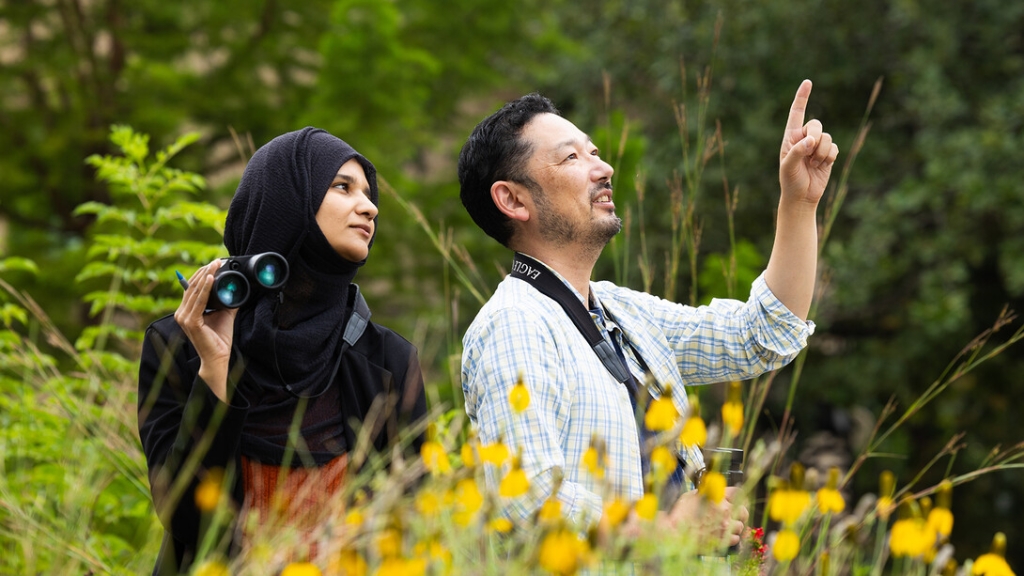
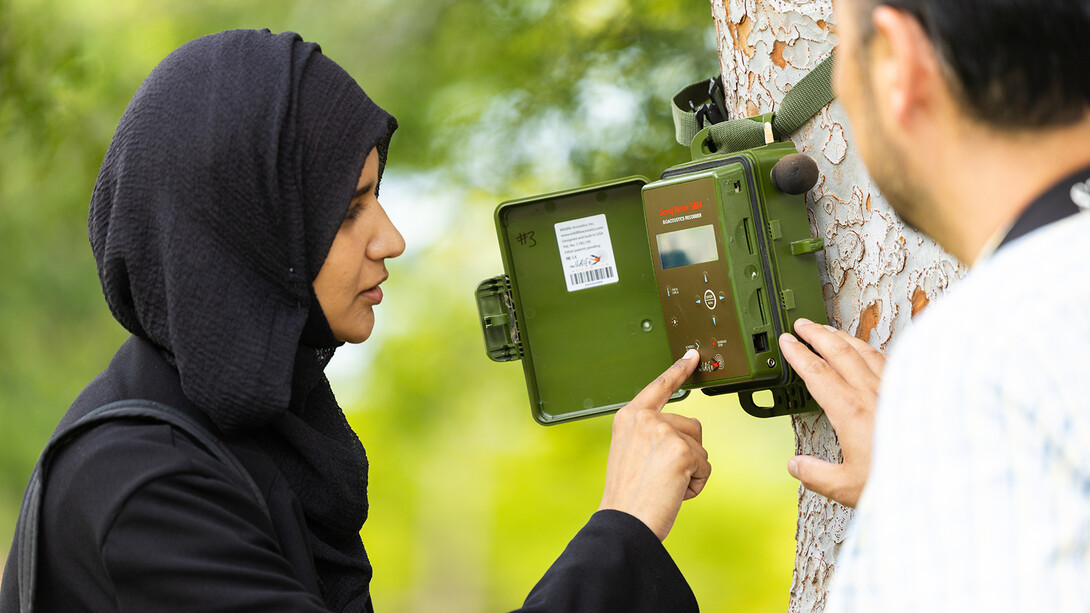
To overcome this, Shizuka and Hafeez will use a microphone array system to track red-winged blackbirds’ vocalizations and movements during natural interactions and measure how an alarm call moves through the population. In addition to typical observation with binoculars and notebooks, the pair will mount microphones on fence posts positioned at even intervals around the bird colony. When at least three microphones pick up the same sound, the researchers can use triangulation strategies to determine where it came from.
“If we do that for all the alarm calls that happen in a colony, we can track how an alarm call that originated from one bird spreads across space,” Shizuka said. “That could happen pretty quickly, and it would be really hard to study the old-fashioned way.”
The team will use the AI-powered BirdNET App, a bird identification tool developed by the Cornell Lab of Ornithology, to identify the sounds on their recordings. Shizuka said this approach will reduce the workload by eliminating the need to sift through data and identify each sound. It will also give undergraduate students the opportunity to refine the model.
“We’ll have trained students go through and label the sounds ‘correct’ or ‘incorrect,’ which will teach the model further,” he said. “The training is an additional benefit.”
The team is also collaborating with the Johnny Carson Center for Emerging Media Arts to develop a museum exhibit that recreates how a red-winged blackbird colony communicates. A speaker array will play birdcalls until a visitor walks in, at which point motion sensors will trigger an “alarm call” that cascades in a realistic manner. Eventually, the birdcalls will return to normal, as they would in nature.
Shizuka said lessons learned from the work might be relevant to other systems involving communication between entities not in the same space, like neural circuits, communications infrastructure and robotics applications. But for he and Hafeez, the objective is simpler — they want to better understand the communications phenomena of birds they routinely see and hear in the field or while walking the neighborhood.
“For us, the original inspiration is understanding what actually happens in nature,” he said. “If I hear a blue jay call, then all of the other blue jays start calling, and then they come together, I can speculate there is probably something in the tree that they’re alarmed by. I want to understand how that alarm system works.”