
This guidance is intended to provide resources to the UNL campus community regarding implementation of NSPM-33 policies and procedures.
What is NSPM-33 and why is it important?
In response to increasing concerns of foreign government interference and exploitation of federally funded research, the U.S. government issued National Security Presidential Memorandum 33 (NSPM-33) in January of 2021. NSPM-33 directs agencies and departments to focus on the following areas:
- Disclosure Requirements and Standardization
- Digital Persistent Identifiers
- Consequences for Violation of Disclosure Requirements Information Sharing
- Research Security Programs
In January 2022 the National Science and Technology Council issued Guidance for Implementing NSPM-33 to federal departments and agencies regarding their implementation of NSPM-33, and general guidance for research institutions (receiving 50M or more in federal funding) to establish research security programs with the following elements:
- Cybersecurity
- Foreign travel security
- Research security training
- Export control training
Following this guidance and as recipients of federal funds, UNL is required to apply certain safeguarding protocols and procedures to its research endeavors. The Office of Research & Innovation, NU ITS, and RCIS have been working since this guidance was issued to ensure that our cybersecurity, disclosure, and training policies and procedures for research meet these requirements.
Disclosure Requirements
Disclosure requirements are two-fold and are intended to address COIs and/or COCs:
- Annual completion of the COI/COC disclosure, along with necessary updates within 30 days as applicable, in Nuramp;
- Ensuring accurate and updated biosketches, CVs, and Other Support is provided to each applicable federal sponsor to address any COIs and/or Conflicts of Commitment. UNL researchers should partner with the Office of Sponsored Programs to ensure this is completed.
The principles that make a robust UNL COI/COC program important are of significance to our federal sponsors and the University of Nebraska (NU) Board of Regents. Updates to the UNL COI/COC Policy and disclosure occurred in 2024 to align with NSPM-33 needs along with NU Board of Regents policies and NU Executive Memorandum 36.
As stewards of public funds and resources, it is critical for UNL employees to transparently disclose information regarding actual, potential, or perceived COIs/COCs. A COI/COC is a situation, not a behavior. Disclosing this information does not mean wrongdoing has occurred. Disclosure allows your supervisor(s) and UNL compliance staff to fairly and independently determine if a conflict exists that requires some form of management.
Violation of disclosure requirements may have criminal, civil, and/or administrative consequences. UNL research personnel are ultimately responsible for ensuring that they make any necessary disclosures required by sponsors and internal policy and follow any prescribed plan for the management, reduction, or elimination of a real or perceived conflict or interest/commitment. Failure to disclose or providing false, misleading, or incomplete information is a violation of University Policy and may have significant consequences with federal sponsors.
Digital Persistent Identifiers (DPIs)
The ORCID iD is an open, nonprofit registry that provides researchers unique identifiers that can be used to consistently and accurately find researchers and their scholarly activities. The identifiers are unique and persistent, allowing researchers and their work to be tracked through entire careers, regardless of name changes or having similar names to other scientists.
Many publishers, including Wiley, Springer Nature and PLOS have started to require ORCID identities as part of the publication submission process. Also, numerous federal funding agencies strongly encourage their use.
Registration is fast and free, and researchers can link an ORCID profile to the university’s single sign on system. Once registered, researchers can search databases like CrossRef and Scopus for publications to link to ORCID profiles.
Registration for an ORCID identity is available online.
DPIs are now required for research personnel receiving federal funding. The UNL Libraries can assist researchers with this process.
Consequences for Violation of Disclosure Requirements Information Sharing
Federal sponsors and agencies have long expected certain compliance requirements to be met as part of receipt of funding and the responsible conduct of research. It should be no surprise to the UNL research community that consequences for violations of NSPM-33 requirements can occur. Depending on the nature of the violation, agencies may consider a range of consequences. Examples include, without limitation:
- Suspension or termination of funding
- Required re-training or other mitigation strategies
- Civil and criminal penalties under US federal and State laws may apply
- Additionally, federal agencies may now also share information. Thus, a violation with one federal sponsor may be reported and impact or cause action from additional federal sponsors for both individuals and the university.
While there are no specific action items on this section, the overall conduct of the work and ensuring that DPIs, transparency/disclosure, and training requirements are met are critical in ensuring individuals and our university do not face consequences for non-compliance with NSPM33 expectations.
Research Security Programs
Expectations for the establishment of research security programs include the following key areas:
- Cybersecurity: OR&I, NU ITS, and RCIS have been working for some time to ensure our cybersecurity practices in research environments meet not only the expectations of federal sponsors but also the expectations of the University of Nebraska. Research personnel are reminded to follow:
- NU Executive Memorandums 16, 41, and 42
- Best practices for Research Security & Research Data Security Checklist
- Budgetary needs: in some cases Medium and High levels of security require additional budgeting and planning to comply with security expectations. Researchers should consider their budget needs at the proposal stage and through the life of the project, including the need for long-term storage and retention options.
- Foreign travel security: If research personnel are traveling for university related business purposes, they must follow all university and federal sponsor expectations for foreign travel approvals and security. UNL RCIS has updated NuRamp notifications for all international travelers to include information on foreign travel security best practices. The university will not reimburse personnel who do not comply with travel policies.
- Export control training: UNL has already been meeting this expectation as applicable.
- Anyone involved in an export controlled activity is required to complete Export Control training prior to engaging in such activities.
- Export controls apply to a broad range of activities, entities, and people at UNL- not just those receiving certain federal funds or working in particular areas. Personnel must understand at least the basic areas where they may encounter export control requirements, such as travel, hosting visas, shipping, and activities on campus.
- Research security training: Requirements for meeting research security trainings are significant. Trainings created and offered by the lead agency in this area, NSF, are time-consuming (approximately 4 hours).
OR&I and RCIS have evaluated the available trainings both federally and internally while focusing on a couple of key items: reducing burden/confusion in various training needs and providing the best possible training for our campus. With this in mind, we have decided on a “Responsible Conduct of Research (RCR) for All,” approach.
Why have we decided to incorporate research security into an overall RCR training?
Research Security is one of the many pillars in the overall Responsible Conduct of Research (RCR). Some federal sponsors already require RCR and research security training for non NSPM-33 purposes. Further, RCR core topics are frequently referenced and woven into other trainings and we believe this overall RCR/ethics training is important to our campus culture of responsibility and understanding of the larger research enterprise. While we have made this “RCR for All,” decision to satisfy NSPM-33 needs, we wish to reiterate that the value and importance of RCR training is not tied solely to NSPM33. RCR is– integrity in all we do, whether that is for a specific funding requirement or otherwise.
Thus, we have decided to more thoroughly incorporate research security training into a comprehensive Responsible Conduct of Research training. This will be available at the beginning of the Fall 2025 semester via a customized module in Learning Bridge. Research personnel will be required to complete a comprehensive RCR training every 4 years along with a brief refresher annually. In some cases, federal sponsors will not allow a proposal to be submitted and/or awarded without this training completed.
Sponsor Risk Factors & Requirements
Risk Factors & Requirements by Sponsor
Guidance, definitions, and requirements for research security and/or disclosure expectations vary by sponsor. Basic information from our most common federal sponsors is listed below. If a sponsor is not listed, it does not necessarily mean they do not have a requirement. Please always refer to sponsor guidance.
The majority of, if not all, federal sponsors listed below are now utilizing SciENcv for ensuring Current & Pending Support and Biosketches are completed along with malign foreign talent recruitment (MFTRP) certifications are completed for proposal submissions and awards.
The chart below provides a general overview of the risk factors considered by federal agencies. While there are differences in how each agency determines risk, they are all concerned about the following, especially if involving a Foreign Country of Concern:
- Undisclosed support,
- Undisclosed affiliations and,
- The type of work involved (e.g. critical emerging technology)
- Participation in Malign Foreign Talent Recruitment Programs (MFTRPs)
Agency Risk Matrix
The following chart provides known factors that the listed agencies consider high risk. It is not intended to be comprehensive and is based on agency guidance that has been issued to date and is subject to change without notice. For Agency specific rules and considerations, see the detailed information below the chart or follow the QR code for more information from each agency.
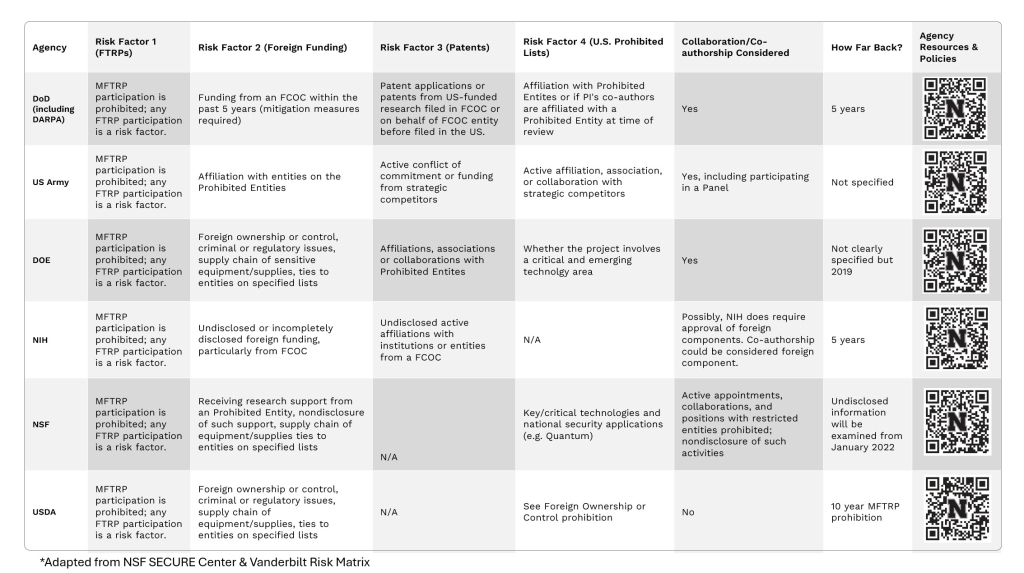
1 – For all agencies, the more recent the participation in Foreign Talent Recruitment Programs identified as Malign or associated with Foreign Countries of Concern, the higher the identified risk. Active participation in a Malign Foreign Talent recruitment program is prohibited by all federal funding agencies. As a reminder, the University of Nebraska prohibits all Foreign Talent Recruitment Programs, regardless of country affiliation.
2 – The U.S. Army’s program has significant differences from the general DOD program, so it is broken out separately
3 – NSF is implementing its research security program, TRUST (Trusted Research Using Safeguards and Transparency), in phases. Phase I began Fiscal Year 2025 (October 1, 2024) and is initially focused on Quantum related research.
4 – If an affiliation is identified in the past 5 years, DOE may ask for a signed assurance from the investigator that the affiliation is no longer active.
5 – Most agencies consider January 2022, the date the NSPM -33 Implementation guidance was published with the expected disclosure requirements as the date investigators should have been aware of these requirements. Indicators of non-disclosure after that date will likely result in a higher identified risk.
6 – While NIH hasn’t identified co-authorship as a risk indicator, NIH does consider foreign co-authorship on an NIH funded paper a potential Foreign Component requiring prior approval.
Note on Co-authorship: Whether your international collaboration is a simple co-authorship or a “foreign component” requiring prior approval from the National Institutes of Health (NIH) depends on the nature of the foreign partner’s contribution. Under the NIH Grants Policy Statement (NIHGPS), a foreign component is defined as any significant scientific element of a project that is performed outside of the United States, whether or not NIH grant funds are expended.
Co-authorship with a foreign colleague does not automatically trigger the “foreign component” requirement for prior approval. However, it requires prior approval if the foreign co-author’s contribution includes any of the following:
- Performance of Research: Significant research activities conducted at a foreign site (e.g., experiments, data collection, or laboratory work).
- Resource Sharing: Use of facilities or equipment at a foreign institution that are not available at the domestic institution.
- Materials and Subjects: Involvement of foreign human subjects or animals.
- Extensive Data Analysis: Performance of substantial data analysis at a foreign site that is critical to the project’s aims.
Federal Restrictions: Equipment Services and Collaborations
Background on Regulations
DOD: The DoD Fundamental Research Decision Matrix prohibits the use of DoD funds for fundamental research conducted in collaboration with, or using equipment from, entities appearing on DoD Prohibited Entity Lists. The restriction applies not only to new purchases but also to equipment already owned and used on DoD-funded projects, requiring researchers to stop using this equipment or work with DOD to develop transition or mitigation plans. Additional research security restrictions apply to collaborations (even co-authorship) with Prohibited Entities, foreign funding from countries of concern, and participation in malign foreign talent recruitment programs.
NSF: NSF announced on July 8, 2026, its intent to implement in Fiscal Year 2027 a new policy prohibiting (1) use of NSF funds on collaborations with entities on certain U.S. restricted parties lists, lists, and (2) senior/key personnel on NSF-funded projects from holding an appointment or position with, or receiving research support from, these restricted entities for the duration of their NSF award. Although the policy is scheduled for full implementation in FY2027, NSF has already begun incorporating these restrictions into certain award and proposal review processes.
Other Agencies: While other major federal research funding agencies, such as NSF, NIH, DOE, and USDA have implemented similar risk review processes and/or rely on U.S. restricted party lists (including the 1260H list) to assess international affiliations and collaborations, they have not yet imposed prohibitions—like those of the DoD—on the use of equipment from listed entities.
However, the BIOSECURE Act, enacted on December 18, 2025, does broadly restrict procurement involving biotechnology products or services over the course of several years. While not effective in the immediate-term, under this Act, federal agencies and entities that receive federal funds cannot “procure or obtain any biotechnology equipment or service produced or provided by a biotechnology company of concern,” (BCC) and agencies and grantees are also prohibited from entering, extending, or renewing a contract with an entity that uses equipment or services provided by a BCC.
Entities are automatically designated as a BCC through inclusion on the 1260H list. In addition, the Office of Management and Budget has been directed to determine which additional entities should be classified as BCCs by December 18, 2026, and to publish a list annually. The prohibition is anticipated to become effective in Summer/Fall 2028. What is not known is whether individual federal agencies will, like DoD, implement their own prohibitions on equipment from 1260H listed entities in advance of BIOSECURE Act implementation.
Additionally, NIH issued a reminder notice on May 27, 2026, regarding its “longstanding definition” of a foreign component. Here is a brief summary as taken from COGR: NIH stated that it has not expanded this definition. Yet, institutions have noted that certain NIH institutes and centers are flagging any foreign coauthor on a NIH-supported publication as evidence of a foreign component, without fully evaluating whether the underlying scientific relationship constitutes the performance of “a significant scientific element or segment of an NIH-funded project performed outside of the United States.” NIH noted that while most instances of foreign co-authorship represent a foreign component, in some cases coauthorships may result from minor or indirect contributions that do not constitute an actual scientific collaboration and in other cases, the underlying research collaboration was actually carried out while the co-author was in the United States. Several federal agencies (e.g., DoD and DOE) have also incorporated publication relationships and co-authorship into broader research security review frameworks, using such information as one factor among many when assessing the nature and extent of foreign engagement associated with federally funded research.
- Disclosure expectations increasingly extend beyond traditional notions of scientific collaboration. NIH’s Reminder reflects a growing federal interest in obtaining visibility into a broad range of foreign relationships, affiliations, activities, and publication-related connections. In some circumstances, agencies may seek disclosure and review of foreign engagements even when the underlying activity does not involve substantive intellectual collaboration, a shared research effort, or a significant transfer of knowledge. At the same time, coauthorship is increasingly considered a factor in agency research security risk assessment frameworks, where publication relationships are evaluated alongside foreign affiliations.
- Increased attention to the Stevens Amendment. The Stevens Amendment (Section 511 of Public Law 101-166) is an appropriations provision that requires grantees of the Department of Labor, Health and Human Services and the Department of Education to clearly identify the percentage and dollar amount of federal funding supporting a project in publicly disseminated materials describing program accomplishments. NIH’s Grants Policy Statement implements the Stevens Amendment by requiring recipients of HHS funding to acknowledge federal support in statements, press releases, requests for proposals, bid invitations, and other documents describing projects or programs funded in whole or in part with federal funds. Specifically, recipients must disclose (1) the percentage and dollar amount of the total project or program costs financed with federal funding, and (2) for programs requiring cost sharing, the dollar amount of total project costs financed by nongovernmental sources. Why this matters: While historically enforcement of the requirement has been focused on bringing recipients into compliance rather than imposing severe sanctions, noncompliance with the Stevens Amendment can be treated as a breach of award responsibilities that could ultimately lead to suspension, termination, or debarment remedies available under broader federal grant authorities. It could also, potentially, form the basis for False Claims Act enforcement efforts. Institutions should consider educating faculty on the requirements of the Stevens Amendment as part of larger communication efforts regarding responsible and ethical authorship and citation practices.
New federal research security requirements are restricting the use of goods and services from, or collaborations with, certain restricted entities in federally funded research.
- Effective May 8, 2026, The DoD Fundamental Research Decision Matrix prohibits the use of DoD funds for fundamental research conducted in collaboration with, or using equipment from, entities appearing on DoD Prohibited Entity Lists. Of the current 13 prohibited lists, the three main ones include the DoD1260H List, DoD1286 List and BIS Entity List.
- In addition, the DoD has issued a prohibition on the use of Anthropic AI platforms (i.e. Claude) in connection with DoD funding.
- NSF announced on July 8, 2026, its intent to implement in Fiscal Year 2027 (October 2026) a new policy prohibiting (1) use of NSF funds on collaborations with entities on certain U.S. restricted parties lists, and (2) senior/key personnel on NSF-funded projects from holding an appointment or position with, or receiving research support from, these restricted entities for the duration of their NSF award. Although the policy is scheduled for full implementation in FY2027, NSF has already begun incorporating these restrictions into certain award and proposal review processes.
- For a list of other prohibitions on equipment, software, or services that are already in effect, see the FAQ below titled “What other equipment terms and conditions should you be aware of and make sure to follow?”
We understand that these updates and issues are complex If you have any questions, please reach out to the Research Compliance, Integrity, and Security (RCIS) Office: rcr@unl.edu or 472-6965
What do I need to do?
- DOD: Researchers who have or expect to apply for DoD funding must immediately identify and cease any collaborations with, or use of equipment from, entities on DoD Prohibited Entity Lists in DoD-funded projects. Additionally, do not make any new purchases from, or enter into any new collaborations with, any of those entities. Of the current 13 prohibited lists the three main ones include the DoD1260H List, DoD1286 List and BIS Entity List. Review the FAQs below for guidance on how to determine if an entity (company, university, or individual) is on a prohibited list.
- In addition, researchers who currently have or are anticipating DoD funding must immediately cease using the Anthropic AI platform (i.e. Claude).
- NSF: Researchers who have or expect to apply for NSF funding should review the Dear Colleague Letter and their collaborations for relationships with entities on the U.S. restricted parties lists. Although the policy is scheduled for full implementation in FY2027, NSF has already begun incorporating these restrictions into certain award and proposal review processes.
- The BIOSECURE Act, enacted on December 18, 2025, will phase restrictions that prevent federal funding recipients from using biotechnology equipment or services from “biotechnology companies of concern” in the performance of federal contracts or grants.
- Other federal funding: Researchers who have or expect to apply for other federal funding should plan ahead by reviewing and identifying alternatives to equipment, services, software, and collaborations from or with entities on DoD Prohibited Entity Lists. and other U.S. restricted parties lists, particularly biotechnology equipment and services ahead of implementation of the BIOSECURE Act.
- Non-federally funded activities: Procurement of equipment or services from restricted parties may be considered if no viable or cost-effective alternative exists. Discuss these purchases in advance with your college/department leadership, Procurement, and the RCIS Office. However, equipment and services from restricted entities should not be purchased for use in spaces where federally funded research may take place, such as core facilities, recharge centers, and other shared facilities and resources on campus.
*See FAQs below for guidance on how to determine if an entity is on a prohibited list.
FAQs
What can you do to prevent issues?
- Review outside activities for terms consistent with a malign foreign talent recruitment program or related activity. If you are unsure whether a potential activity qualifies, contact the UNL RCIS Office.
- Ensure you have approval from your federal sponsor prior to including a foreign collaborator or co-author (or being added as one yourself).
- Provide full and accurate disclosures in all required documents (e.g., biosketch, Other Support, proposal disclosures, and project updates). This includes but is not limited to:
- Appointments or affiliations (paid, unpaid, visiting, honorary)
- Funding or in‑kind support (research, travel, materials, equipment)
- Patent filings, invention disclosures, and IP agreements
- International collaborators and co-authors
- Any current or past involvement with talent recruitment programs
- Carefully vet current or planned collaborators and co‑authors, especially in science and engineering fields and particularly if individuals are affiliated with a Foreign Country of Concern.
- Request restricted party screenings through the UNL RCIS Office. RICS can verify whether any collaborators, co‑authors, institutions, or companies are on any prohibited lists.
- For any U.S. government–funded research: Do not file patent applications in foreign jurisdictions before filing in the United States. Ensure all related IP activity is fully disclosed to the university and in sponsor documentation.
- For DoD funded work, ensure that any equipment you plan to use is not sourced from an entity on a Prohibited Entity List. Again, the RCIS Office can help confirm equipment providers are not restricted parties.
- Ask questions early and often. If something is unclear—or if you think an issue might be a concern—contact the RCIS office for guidance.
- Reach out to the RCIS office to conduct restricted party screening when considering a new collaboration or when a current or intended collaborator or co-author is leaving the U.S. for a foreign institution
How can I screen a collaborator or vendor?
Certain federal sponsors now require that any collaborator and/or equipment research personnel plan to work with does not involve or is not sourced from or manufactured by an entity listed on a Prohibited Entity List. Because multiple such lists exist, the University of Nebraska subscribes to a third-party tool, Visual Compliance, that consolidates and maintains up-to-date versions of these lists. As the lists change over time, the most effective way to remain compliant is to use the Visual Compliance screening tool to conduct restricted party screenings. Your campus’s Export Control Office can assist with restricted party screenings upon request.
Do I need to screen all purchases used in my research?
Ideally, yes. We recognize that screening every purchase is not always feasible. Researchers are advised to focus screening efforts on items associated with critical or sensitive technologies and higher‑risk purchases rather than low‑risk, routine items such as common laboratory or office supplies that are readily available through standard commercial vendors.
Are all purchases automatically screened?
No, not all purchases are automatically screened. Purchases processed through the University of Nebraska’s Procurement vendor system are automatically screened. However, purchases made using a P-card (procurement card) are not automatically screened. If you are using a P-card, you are responsible for ensuring that appropriate screening is completed.
Which purchases should be prioritized for screening?
Ideally, all DoD and NSF funded purchases should be screened. Screening should be prioritized for higher‑risk equipment and technologies, particularly those that may be relevant to export controls, national security concerns, or specialized equipment or computing software. Routine, low‑risk items (general lab equipment) may not require the same level of review.
Are there specific suppliers or lists I should be aware of?
Yes. The DoD and NSF emphasized the importance of avoiding purchases from entities on the DoD1260H List and the DoD1286 List. When feasible, higher‑risk purchases should be screened against all applicable restricted or prohibited party or entity lists, consistent with University policy and federal requirements of not purchasing or using equipment from Prohibited Entities or parties.
Does this guidance apply to past purchases?
Possibly, DoD and NSF have not been specific on this portion. We recommend that you please flag any past purchases from Prohibited Entities and do not use them. Notify the Export Control Office for your campus if you identify any impacted equipment or services and they will assist with next steps in coordination with the PI and your department of college leadership. We are also researching past purchases and agreements through Procurement and Sponsored Research.
What other equipment terms and conditions should you be aware of and make sure to follow?
Each federal agency’s guidance, awards and agreements differ, and you need to ensure that you follow the terms and conditions. Some of the restrictions include but are not limited to the following:
- BIOSECURE ACT: Section 851 of the NDAA.
- Prohibition on Contracting for Hardware, Software, and Services Developed or Provided by Kaspersky Lab Covered Entities FAR 52.204-23
- Prohibition on Contracting for Certain Telecommunications and Video Surveillance Services or Equipment FAR 52.204-25
- Prohibition on Unmanned Aircraft Systems Manufactured or Assembled by American Security Drone Act-Covered Foreign Entities FAR 52.240-1 Reference this resource related to Drone purchases.
- National Security and Unallowable Costs – USDA Terms and Conditions though we expect other agencies have or will adopt similar terms
Resources: Collaborations, Co-Authorship & More
We have issued many other related guidance documents over the last several months/years. Please see the below for additional resources, particularly for screening collaborators to ensure you are not collaborating with a restricted or prohibited party.
- NSPM-33 and Federal Agency Risk Assessments
- Restricted Party Screening
- Foreign Influence & International Activities
- Research Data & Security Required Training
- Transparency in Research-Federal Agency Biosketch/Other Support Disclosure Requirements
Plans for campus implementation
We are planning a phased rollout for research security (RCR) training:
- Fall 2025 semester: federally funded key personnel, starting with those who have DOE, DOD, and NSF funding. Other covered personnel will be required to complete training during this phase as dependent on funding source. To meet federal deadlines, the training must be completed prior to October 10th, 2025.
- Spring 2026 semester: other federally funded key personnel- NIH, USDA, Dept of Ed, DOJ etc. To meet federal deadlines, the training must be completed prior to January 25th, 2026.
- Fall 2026: by the end of October, 2026 all other research personnel, funded or unfunded, including graduate students, will be expected to complete RCR training.
We encourage all research personnel to complete the RCR training as early as possible to avoid any funding delays.
Action Items
- If you are involved in research and are not yet utilizing a digital persistent identifier (DPI), create an account to begin DPI use or contact the Libraries for assistance.
- Disclosure:
- Ensure your annual COI/COC disclosure is complete and up to date in Nuramp at least annually and throughout the year if updates are necessary.
- Ensure your CVs, Biosketches, and Other Support are up to date and provided in accordance with your federal sponsor requirements.
- Training: Check back on this website about training availability beginning in the Fall 2025 semester. Complete training as early as possible given that some funding agencies may require training at the proposal submission stage and/or make funding decisions contingent on training.
- If you are involved in or considering participation in a foreign collaboration/activity that may be of concern, contact the RCIS Office for assistance.
Resources
The following resources listed below will help connect or guide you further on related topics:
UNL COI/COC Policy & Definitions
Foreign Influence & International Activities
Responsible Conduct of Research (RCR)
Research Security FAQs, Guidance, and Templates
Transparency in Research: Federal Agency Biosketch/Other Support Disclosure Requirements
Research Security Point of Contact: Sara Quinn (squinn@unl.edu, 472-4491)