Mechanical and Materials Engineering
Tiffany Lee, August 18, 2026
Nama advances software to expand ultrasound’s role in medicine
Ultrasound has long enabled doctors to peer inside the body and treat certain conditions without a scalpel. Now, researchers envision a next frontier of sound wave-based technologies for targeted drug delivery, blood clot dissolution, surgeries that spare healthy tissue and beyond.
But first, they must answer the longstanding question of how complex fluids inside the human body behave under the influence of sound waves.
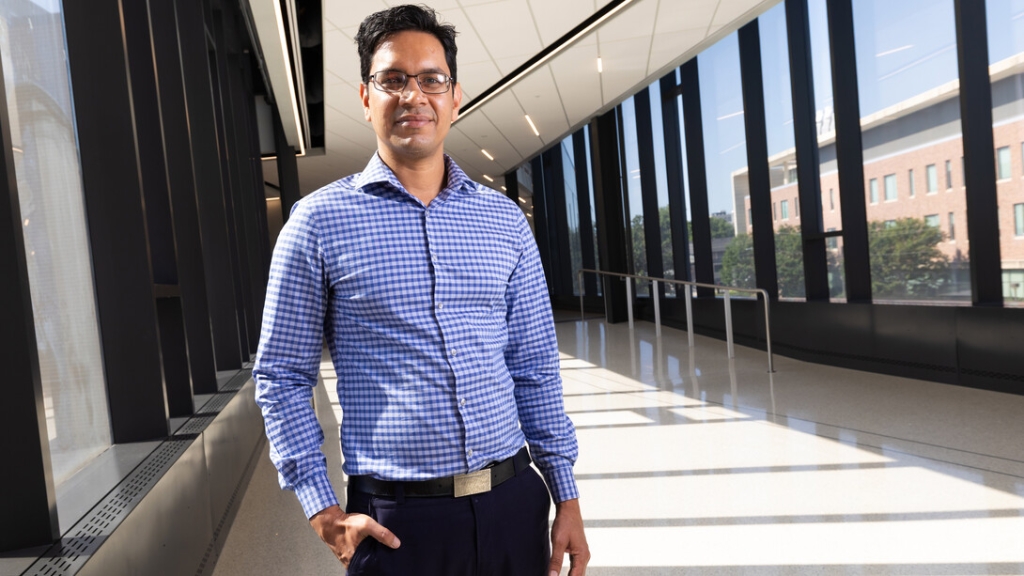
Nitesh Nama of the University of Nebraska–Lincoln will help answer that question with a five-year, nearly $550,000 grant from the National Science Foundation’s Faculty Early Career Development Program. Drawing on his diverse expertise in applied mathematics and mechanical and biomedical engineering, Nama will develop open-source computational software that accurately captures how biological fluids respond to ultrasound. The software will help researchers design more sophisticated ultrasound-based medical treatments by improving their understanding of how sound waves interact with the fluids carrying energy and medicine through the body.
The resource would be one of the first platforms offering the scientific community a rapid, low-cost pathway for generating and testing hypotheses and improving medical devices.
“To this point, most of the research on ultrasound has been done with regular fluids, like water or diluted polymers,” said Nama, assistant professor of mechanical and materials engineering. “But this is not representative of actual use scenarios. In reality, you would be working with blood, mucus or the synovial fluids that fill joint spaces, which don’t flow like water. They are fundamentally different fluids, and we are developing models that account for these differences.”
The gap between research and reality stems, in part, from the cost and complexity of working with the microchannel devices that mimic the human body’s tiny structures like blood vessels, capillaries and spaces inside tissues. Making these human hair-width devices to test ultrasound technologies requires clean room facilities and thousands of dollars.
Conducting experiments with the viscoelastic liquids found in the body — which behave partly like a liquid and partly like a stretchy solid — poses an additional challenge because these fluids often clog channels and leave residues.
“A persistent bottleneck I see in ultrasound research is that reliable, well-characterized experiments of even the most basic setups cost a lot of money,” Nama said.
His CAREER research will help researchers clear that hurdle. By developing computational models that represent the behavior of complex fluids, he is offering the scientific community an inexpensive avenue for experimentation.
“The goal is to have the testing done on the computer, rather than having to make microchannel devices again and again,” he said.
Nama’s work is a unique merger of two mature fields: complex fluids and acoustics. Though both have been studied extensively by themselves, his approach is one of the first to unite them rigorously and fully account for complex fluids’ reaction to sound waves. To do this, he will first identify the mathematical equations that accurately capture the physics, then write computer codes to solve them.
Nama’s project comes at a time when demand for medical ultrasound technologies is surging. Because ultrasound is safe and noninvasive, researchers see it as a key tool as medicine shifts away from one-size-fits-all treatment toward individualized and precision therapies.
For example, Nama previously worked with a team developing tiny, ultrasound-guided polymers that deliver pharmaceuticals to a small, localized region in the body. This minimizes side effects and protects healthy tissue from drug exposure. He has also provided guidance to researchers who are engineering approaches to cleaning dialysis tubes, catheters and stents with ultrasound waves, enhancing patient safety and allowing reuse and longer periods of time between replacements.
Ultrasound’s portability and low cost also make it an attractive technology for point-of-care devices, which have attracted growing interest since the COVID-19 pandemic. Pocket-sized ultrasound devices could link to smartphones, providing real-time information and diagnostics.
To develop the education component of the CAREER award, Nama drew on his own experiences. He has a bachelor’s degree in mechanical engineering, a master’s degree in mathematics and postdoctoral experience in biomedical engineering. This cross-disciplinary resume enables his current work, he said.
“This is a field that requires you to know a bit of everything,” he said. “You need to know the math, you need to know how the human body works and you need to know the engineering of devices and sound waves.”
To help Husker students develop this diverse skill set, he is developing interdisciplinary modules that integrate these fields. Nama will also invite colleagues from industry to share their work on various devices, giving students a window into the commercialization process.
“This would allow them to see what goes on behind the scenes to develop a device,” Nama said. “There’s developing the device itself, then there is the FDA compliance side and the whole pathway to translation.”
He will also work with the University of Nebraska’s Young Nebraska Scientists program to introduce middle and high school students to the basic concepts of sound waves.
The National Science Foundation’s CAREER award supports pre-tenure faculty who exemplify the role of teacher-scholars through outstanding research, excellent education and the integration of education and research.