News & Information
Latest Stories
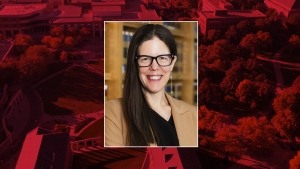
Pannier to lead the Nebraska Center for Biotechnology
Angela Pannier, Swarts Family Chair of biological systems engineering and professor of biomedical engineering, has been named director of the Nebraska Center for Biotechnology at the University of Nebraska-Lincoln.
MoreNebraska U ranks in top 9% worldwide for agriculture, natural resources
The University of Nebraska–Lincoln’s agriculture and natural resources programs rank in the top 9% of nearly 500 institutions worldwide in the new QS World University Rankings.
Nebraska improved its standing from 46th to 40th globally over the past year, reflecting continued gains in academic reputation, research impact and international collaboration.
MoreMetcalf uncovers passion (and mice) via research at Cedar Point
Assisting with research at Cedar Point Biological Station has given Rhianna Metcalf, a senior biological sciences major from Lincoln, the opportunity to participate in hands-on research, expand her network and learn more about a passion she discovered at the station: parasitology. The experience has given Metcalf a greater appreciation for nature’s systems and how they interact.
MoreStudy finds intergenerational co-parenting benefits children
Family dynamics among caregivers tend to be complicated. They can become even more complex when grandparents take on co-parenting roles.
Weiman Xu, postdoctoral fellow at the Nebraska Academy for Methodology, Analytics and Psychometrics, recently explored the association between intergenerational co-parenting and children’s social-emotional development.
MoreMore Stories
Cruise named next director of Center on Children, Families and the Law
The University of Nebraska–Lincoln’s Center on Children, Families and the Law named Dr. Keith Cruise as its director. Cruise will also hold a faculty position as a professor of psychology in the College of Arts and Sciences.
MoreSandhills rancher’s stewardship shaped by Nebraska U research, extension
Longtime Nebraska rancher Homer, Buell’s experience is informing a new UNL research initiative focused on grazing systems and ranch decision-making. As part of the university’s $5 million Advancing Development of Assessments, Practices and Tools project, anthropologist Effie Athanassopoulos and rural sociologist Gwendŵr Meredith are interviewing multigenerational ranch families across Nebraska about stewardship, adaptation and grazing practices.
MoreAwards expand research on melanin-producing fungi, microbial communities
A newly discovered black fungus that thrives in some of Earth’s harshest environments is helping engineering researchers at the University of Nebraska–Lincoln answer a fundamental question: Why would an organism spend valuable resources producing something that benefits others?
MorePoust helps identify new species of feathered dinosaur
Ashley Poust this summer is taking graduate students into Montana to search for dinosaur fossils and mentoring an undergraduate researcher joining a project in Paraguay studying how fossils form, decay and enter the geologic record.
MoreFathers may play outsized role in shaping teen smoking, vaping habits
A new study from the University of Nebraska–Lincoln sheds light on how parental smoking shapes adolescents’ attitudes and use of both traditional cigarettes and e‑cigarettes, finding that fathers’ behaviors may play a more influential role than those of mothers.
MoreNebraska research champion Olsen earns accolades from UNL, Governor’s Office
Kathie Olsen, for more than two decades one of the University of Nebraska–Lincoln’s most steadfast research champions, , was honored for her role in helping nurture and build the university’s research enterprise.
More



Topics
Nebraska Athletic Performance Laboratory
Center for Resilience in Working Agricultural Landscapes
National Endowment for the Humanities
Center for Root and Rhizobiome Innovation
Materials Research Science and Engineering Center
Nebraska Center for Redox Biology
Nebraska Center for Integrated Biomolecular Communication
Gnotobiotic Mouse Program
Nebraska Governance and Technology Center
Arts and Humanities Research Engagement Program
center for resilience in agricultural working landscapes