
Karl Vogel, October 28, 2026
Stoller earns NASA fellowship to advance work on cooling powerful electronics
Truman Stoller, a doctoral student in mechanical engineering at the University of Nebraska–Lincoln, is among 45 students nationwide selected by NASA to receive a 2026 Space Technology Graduate Research Opportunities Fellowship.
It is the third time in 12 years the award has been given to a College of Engineering student. All three — Corey Kruse (2014), Logan Pettit (2021) and Stoller — have been graduate student researchers in the Multiscale Heat Transfer Laboratory of George Gogos, professor of mechanical and materials engineering.
Gogos and Craig Zuhlke, Richard L. McNeel Associate Professor of Engineering in electrical and computer engineering, are co-advisers for Stoller in his interdisciplinary work to develop a wickless heat pipe, which will be supported by the fellowship.
For Stoller, a native of Madison, South Dakota, the achievement reflects years of preparation and mentorship from numerous people.
“It really is standing on the shoulders of the people who came before me,” Stoller said. “Having Logan in the lab and hearing about his experience was incredibly helpful. He helped me understand what NASA was looking for and how to build a successful proposal.”
The highly competitive fellowship provides more than $250,000 over three years to support graduate education and research projects while pairing the selected students with NASA researchers through 10-week summer placements at their facilities.
The application process is rigorous and requires students to map out nearly every aspect of their doctoral studies. Gogos said his lab’s reputation for innovative research and a history helping NASA advance its technologies is evident in Stoller’s selection.
“NASA wants to see not only a strong research idea, but a clear plan for how the student will develop as a researcher,” Gogos said. “Having students like Corey, Logan and now Truman earn these fellowships shows the quality of the work being done here. Each student builds on the work of those who came before, and that’s how research advances.”
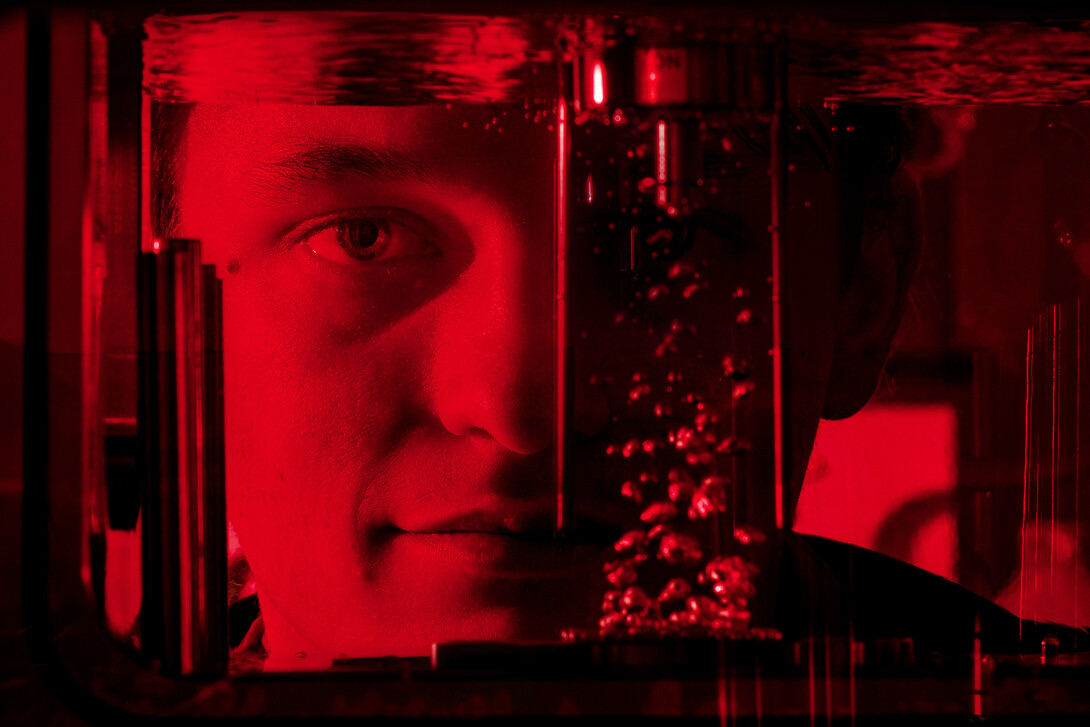
Stoller’s proposed research, “Proposing an Advanced Heat Pipe: An Innovative Pumpless Flow Boiling Device,” focuses on improving an established technology that quietly plays an essential role in modern electronics, spacecraft systems and advanced aerospace applications.
A heat pipe is a sealed device that moves heat from where it is generated to where it can be safely dissipated. The technology uses a continuous cycle of evaporation and condensation. Liquid absorbs heat and evaporates, the vapor travels to a cooler region, condenses back into liquid and then returns to repeat the process.
Traditional heat pipes rely on a wick structure to move liquid back to the heat source.
Stoller hopes to eliminate that wick entirely.
“So, this will be like a wickless heat pipe,” Gogos said. “We will use lasers to functionalize the interior surfaces, and when you put a liquid on those surfaces, it naturally wicks. If we can use the surface itself instead of a separate wick, we can improve performance.”
The approach builds on years of work in the college’s Multiscale Heat Transfer Laboratory and the Center for Electro-Optics and Functionalized Surfaces. Researchers use laser processing to create microscopic surface features that dramatically improve capillary action, the same physical phenomenon that allows liquids to move through tiny channels.
Zuhlke said the team’s laser-processing techniques can be tailored to optimize fluid movement for different applications.
“We use the laser to functionalize the surface to create super-wicking behavior,” he said. “We can tune the laser parameters and understand how those changes affect wicking performance. That gives us the ability to design surfaces for a variety of thermal-management applications.”
If successful, the technology could improve one of the most important challenges facing both NASA and industry: keeping increasingly powerful electronics cool.
Modern computer processors generate enormous amounts of heat, and thermal-management limitations often constrain performance. The challenge is especially significant in data centers supporting artificial intelligence systems, where cooling demands continue to increase.
NASA faces similar concerns in spacecraft avionics and other electronic systems, but with even tighter constraints.
One reason NASA is interested in the technology, Stoller said, is the ability of heat pipes to move heat without pumps. Eliminating pumps reduces size, weight and power consumption, all critical considerations for spaceflight systems.
The benefits may extend beyond spacecraft. Heat pipes are already used in laptops, smartphones and other electronics, and researchers have explored their use in next-generation aircraft and hypersonic vehicles where extreme heat loads can threaten structural materials.
“There has been a lot of research on heat pipes to improve them,” Gogos said. “Hopefully over the next four years, Truman can help solve this problem and improve heat-pipe performance for NASA and many other applications.”
The fellowship also includes annual visits to NASA research centers, giving Stoller the opportunity to work alongside agency scientists and engineers. He expects the experience will play an important role in shaping his career after graduation.
As meaningful as the financial support will be, Stoller sees the opportunity to collaborate with NASA as the fellowship’s greatest value.
“This fellowship opens doors I never imagined,” Stoller said. “Working with NASA researchers, seeing the kinds of problems they’re solving and being part of that environment is going to be incredibly important for whatever comes next.”


