Troy Fedderson, October 30, 2026
Fellowship to expand Mueller’s work on America’s founders
Who gets to help shape America? And how do religion and identity influence who feels welcome in its civic life?
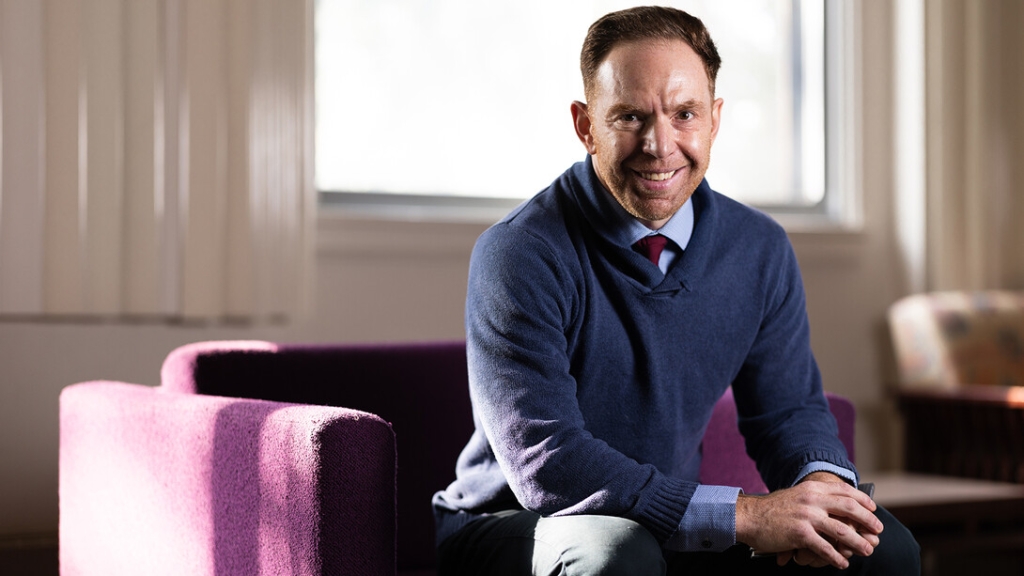
Max Perry Mueller, a religious studies professor at the University of Nebraska–Lincoln, will explore those questions as one of nine scholars selected for the 2026-27 Public Fellows program at the Public Religion Research Institute.
Kristen Labadie | University Communication and Marketing
The 11-month fellowship brings scholars from different disciplines together to study religion’s role in American civic life and bring academic research to broader audiences. Mueller will join the institute’s Pluralism and Democracy research group, where fellows will pursue individual projects while collaborating on research and developing public-facing commentary and analysis.
“This fellowship is an opportunity to take the work we do beyond the university and further conversations that shape how people understand our country,” Mueller said. “I’m honored to be part of a group asking these questions, because understanding how religion, identity and belonging shape our democracy is essential to understanding America itself.”
The group is beginning to define its research priorities, with one potential focus on the place of Muslims in American society and how religion shapes perceptions of political candidates and elected officials. Fellows may draw on the institute’s public opinion survey data to investigate public attitudes and help shape the questions researchers ask.
For Mueller, a historian whose work primarily relies on qualitative research, the fellowship offers an opportunity to work with large-scale survey data and collaborate with scholars from other disciplines. He also hopes to bring a historical perspective to how researchers frame questions about religion and public life.
“One of the questions being asked nationwide is, ‘Can a Muslim be an elected official?’” Mueller said. “That’s a problematic question because it presupposes that Muslims are a problem.”
The broader question, he said, is whether Americans of different religious backgrounds are welcomed as participants in civic life — a central concern of pluralism.
Mueller is the second Nebraska scholar selected for the institute’s fellows program. Kelsy Burke, a sociology professor, joined a 2022 cohort through the institute’s Religion and Renewing Democracy Initiative, participating in a research group focused on LGBTQ rights.
Through the fellowship, Mueller will focus on writing his forthcoming book, “More, America: Twenty-Five (More) Founders of the United States of America,” which is under contract with HarperCollins. The work builds on his recent project profiling figures often overlooked in conventional American history, spotlighting people who shaped the nation beyond the founding fathers.
Mueller’s subjects include Phillis Wheatley Peters, a formerly enslaved poet whose works helped shape American literature and challenged racist assumptions in 18th century America.
“I take inspiration in her writings,” Mueller said. “She establishes a particular African American view on America that many, many others, especially in the 20th century and even in recent history, have continued. In her work, she calls for America to account to be better than itself, to live up to its own ideals.”
Mueller hopes his fellowship colleagues will challenge his assumptions and offer new perspectives on his work. The program is supported by the Mellon Foundation and the Henry Luce Foundation. He will receive a course release in the spring to devote more time to collaborative research. Fellows will meet in person in Washington, D.C., with most of their work taking place remotely.
“America’s founding didn’t just happen in 1776,” Mueller said. “It’s a perpetual project. America is always refining itself with different people participating in that refounding. I’m excited for this opportunity to explore what that means for our understanding of American history and democracy today.”


