office of research and innovation
Dan Moser and Ashley Washburn, May 11, 2026
Convening spurs conversation, excitement about university’s future
The University of Nebraska–Lincoln has unique strengths that faculty can leverage to advance the university’s research mission, university leaders and guest speakers told participants at the May 4 Research and Innovation Convening.
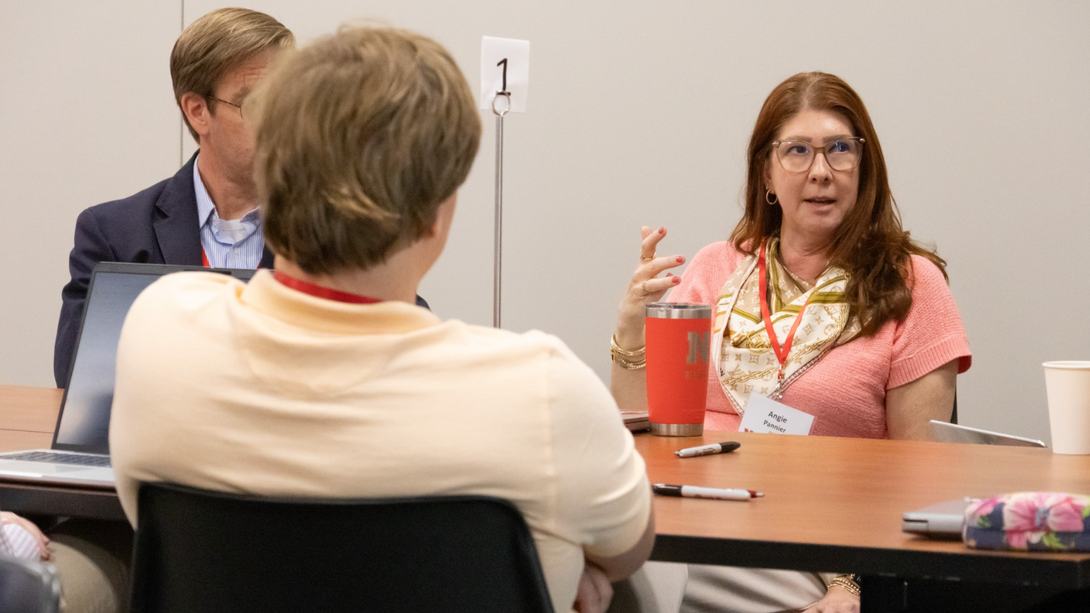
The second annual convening, which drew 175 Nebraska faculty members, was designed to foster community, connection and collaboration. It included the perspectives of university leaders and partners; updates on ideas generated in response to the research identity framework; and exploration of interdisciplinary opportunities at the intersection of those areas and cross-cutting areas of distinction.
Jen Nelson, vice chancellor for research and innovation, started the day by reminding faculty to remember the “why” stories behind their work — a nod to Interim Chancellor Katherine S. Ankerson’s Charter Day speech.
“I encourage you to look within yourself,” Nelson said. “What brings you passion in your work life, and in how you show up as a researcher, a scholar, a creative, an innovator?”
She also discussed the research identity framework and the corresponding themes and cross-cutting areas of distinction, which “will help shape our work for years to come.”
Ankerson said research is a key pillar as the university pursues Our Bold Path Forward, a new strategic framework that will serve as a guide through the 2028-29 academic year.
“When we combine our experiences, our strengths and expertise, we spark discoveries that build lasting impacts,” Ankerson said. “The creativity and innovation of our faculty, researchers and postdocs build a stronger Nebraska and a better world.”
Nelson asked the faculty to consider how collaborations will increase research impact.
“It has become clear that UNL must anchor its research and innovation portfolio in partnerships,” Nelson said. “We should seek collaborative opportunities with government, industry, community partners, foundations, philanthropic organizations and other academic institutions.”
Fundamental research lays the groundwork for innovations with real-world applications, she said.
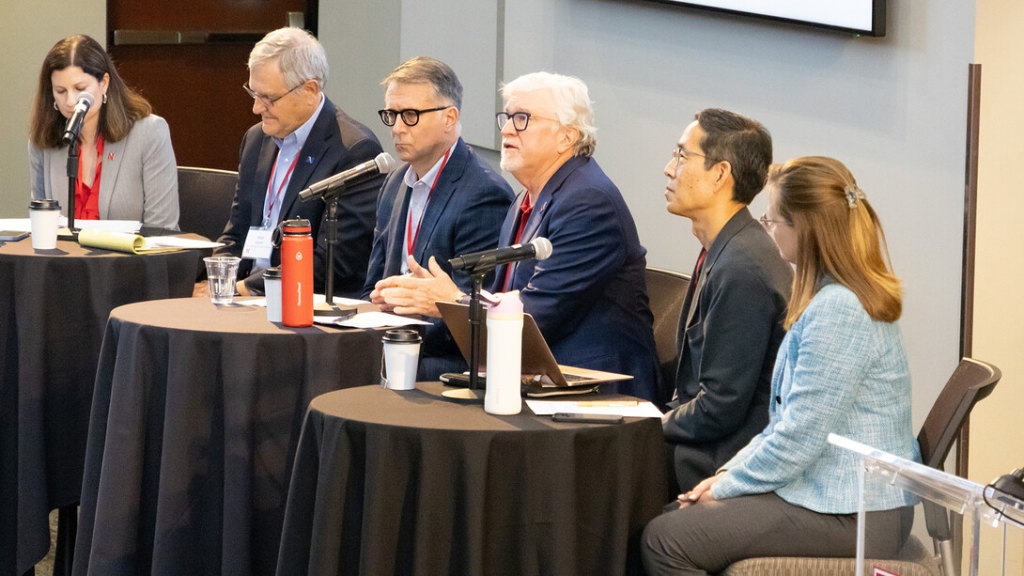
Guest speakers acknowledged the challenges in the research environment — including upheaval in federal priorities and processes, and ongoing budget constraints at the state level — while striking an optimistic view of how Nebraska faculty can continue moving forward.
Panel discussions included representatives from a variety of sectors with which the university has a history of partnership. Common themes among the speakers included navigating the current environment; the need to clearly communicate the value of research; and how universities can work effectively with other sectors.
- Kei Koizumi, a science and technology adviser to the Obama and Biden administrations, said current federal funding is experiencing “enormous disruption” but, for now, spending levels have stayed generally flat. He encouraged faculty to “keep engaging with federal science agencies, even as you try to diversify your funding sources.”
- State Sen. Jason Prokop, representing west Lincoln, said most state lawmakers want to support university research, but given fiscal realities, “every investment is looked at much more closely. There is a growing expectation that public dollars connect clearly to outcomes people can understand and see in their daily lives,” Prokop said.
- Tony Boccanfuso, president and chief executive officer of the University Industry Demonstration Partnership, said industry funding for research has been growing in recent years. In 2024, UNL saw industry contributing about 12.3% of its overall research funding, up from 6.3% in 2010. Industry wants to partner with universities when they see some benefit to them, and the converse is true, too, Boccanfuso said. “Companies want to work with you if you make it easy to work with them, and you under-promise and over-deliver,” he added.
- Brian Hastings, president and CEO of the University of Nebraska Foundation, said private donors can’t replace core funding from government; however, philanthropists want to augment that federal support to provide “a margin of excellence.” The foundation’s current fundraising campaign, Only in Nebraska, is exceeding expectations. Conversations are underway with the four NU campuses’ leadership about the next set of philanthropic priorities that will follow this campaign.
- Kathleen Lodl, associate dean and state 4-H program administrator with Nebraska Extension, encouraged university colleagues to see citizens across the state as “co-creators” in research, and to “listen to the real people of the state and the issues they’re facing. We’re uniquely positioned to do this work, right? We are the University of Nebraska. … People in this state really believe in us and support us,” Lodl said.
An afternoon panel discussion moderated by Nelson gave external partners a chance to expand on themes surrounding research partnerships.
- Jeff Raikes, co-founder of the philanthropic Raikes Foundation, said private donors look for opportunities “to have an impact. And so the things we look for most are where we can catalyze activity through research that will ultimately benefit communities and people.”
- Kim Morrow, chief sustainability officer for the city of Lincoln, discussed a new initiative that aims to draw upon UNL’s expertise to help address city priorities, including affordable housing, food insecurity, community planning and climate resilience. “We have this amazing resource a couple blocks away in our backyard, and I think up to this point, neither side maybe has taken full advantage of that relationship,” Morrow said.
- Alan Dostal, associate director of research at Nebraska Public Power District, noted his organization partnered with UNL two decades ago to create the Nebraska Center for Energy Sciences Research. The center has contributed to advancements in energy technologies and created economic growth across the state. The center has also offered internships for UNL students. “It’s been an amazing partnership,” Dostal said.
- Dan Hoffman, chief executive officer of Invest Nebraska, predicted the changing direction of federal research priorities will continue to encourage development of organizations such as his, created by state legislation in 2001. Bringing together the state’s private sector, the University of Nebraska and the Nebraska Department of Economic Development, Invest Nebraska assists entrepreneurs and collaborates with investors to grow the state’s economy. “The benefit for Nebraska is, you know, we only have 2 million people, and (UNL) is the only flagship university,” Hoffman said. Referring to the famous Kevin Bacon six degrees of separation, Hoffman said there’s only about two degrees of separation among Nebraska’s industry leaders, academia and policymakers.
- Koizumi, who also spoke during the morning session, highlighted ways the federal government relies on universities to spur innovation and global competitiveness. Even though the funding environment has changed, Koizumi said, government is still looking to university partners for ideas, scientific networks and cutting-edge infrastructure. “We don’t expect universities to do it all,” he said. “You have a team to accomplish great things.”
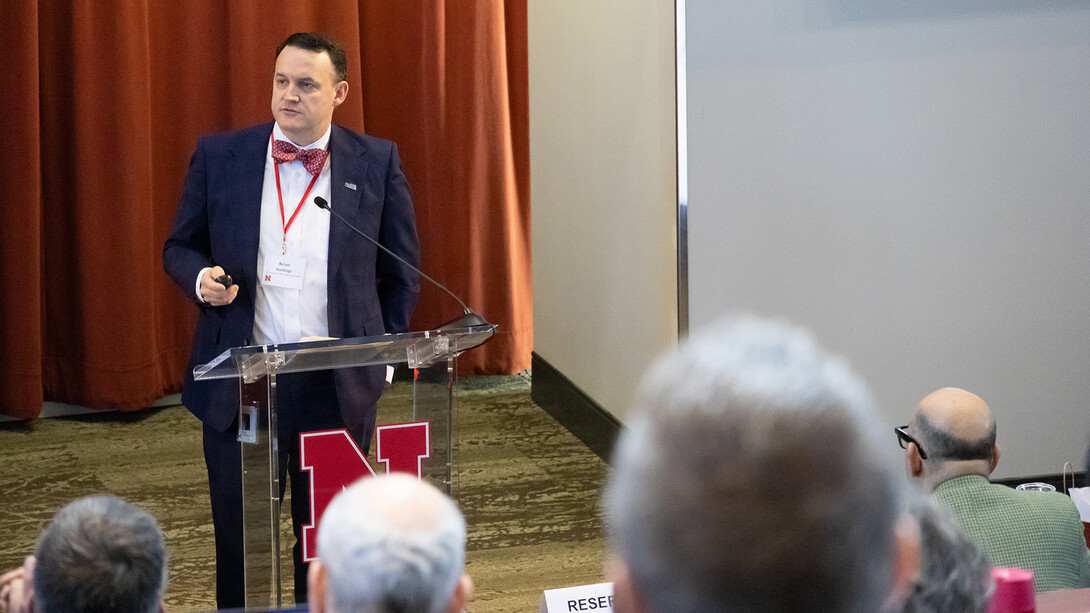
Brian Hastings, president and chief executive officer of the University of Nebraska Foundation, talks about the role of philanthropy in university research.
Other activities during the convening included “flash talks” by faculty and breakout sessions to explore UNL’s six Research Identity Areas: agriculture and bioindustry; basic mechanisms of disease; creative engagement and cultural heritage; material sciences and energy; social, behavioral, educational and prevention sciences; and transportation, infrastructure, robotics and autonomous technologies.
Other faculty talks and breakout sessions focused on “cross-cutting areas of distinction:” artificial intelligence, data management and preservation; economics and business; ethical, legal, social and policy implications; high performance computing; and STEM learning/discipline-based education research.
Nelson said follow-up from the Convening will include the second annual Research and Innovation Showcase in the fall; development of an interactive research ecosystem map; and exploration of new ways to communicate about UNL research.