Natalie Jones, June 25, 2026
Sandhills rancher’s stewardship shaped by Nebraska U research, extension
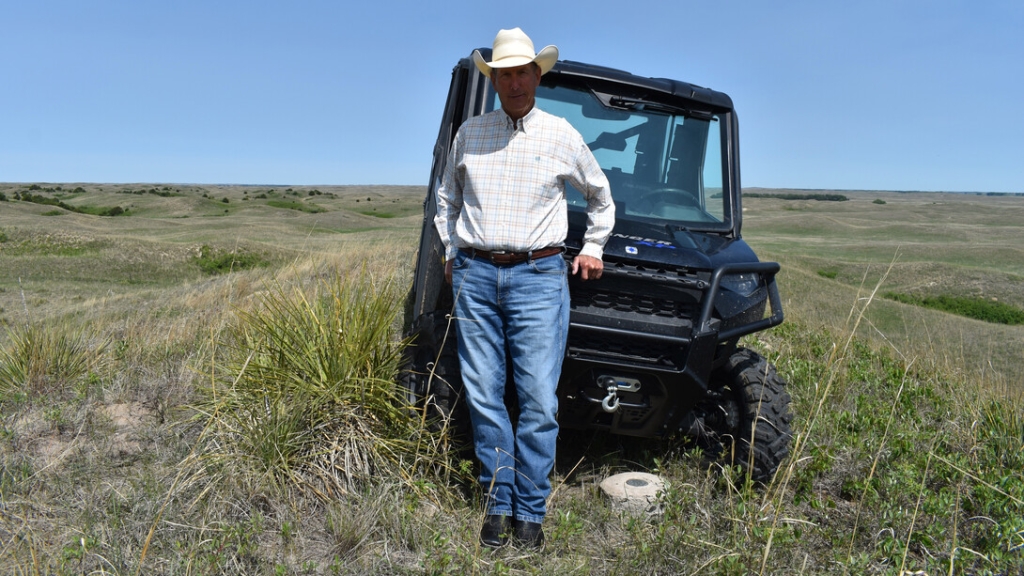
When Homer Buell first returned to his family’s Sandhills ranch after attending the University of Nebraska–Lincoln, his focus was primarily on cattle. Over time, he said, his perspective on ranching shifted.
“When I first came back, I looked out at the cattle,” Buell said. “What I learned over the years was it was more important that I looked down to the ground.”
That shift — from managing cattle to managing grasslands — has shaped Buell’s approach to ranching for decades and reflects a lifelong connection with the University of Nebraska–Lincoln rooted in research, Extension and stewardship of Nebraska’s rangelands.
For more than 40 years, Buell has worked with university researchers, Extension educators and fellow producers to better understand grazing systems, land management and long-term ranch sustainability.
Today, Buell’s experience is informing a new UNL research initiative focused on grazing systems and ranch decision-making. As part of the university’s $5 million Advancing Development of Assessments, Practices and Tools project, anthropologist Effie Athanassopoulos and rural sociologist Gwendŵr Meredith are interviewing multigenerational ranch families across Nebraska about stewardship, adaptation and grazing practices.
Buell was among the first ranchers selected for in-depth interviews.
“We’re talking with ranchers who have been on the land for generations and who are leaders in the industry,” Athanassopoulos said in a previous interview about the project. “What has been especially striking is how environmentally conscious ranchers are and how deeply they care about the land.”
A fourth-generation rancher near Rose, Buell said his connection to the university began in the 1970s and ’80s through Extension relationships and research at the Gudmundsen Sandhills Laboratory and Barta Brothers Ranch.
The Buell family’s ties to Nebraska span generations. Buell’s parents met at UNL, his grandfather served on the Board of Regents and multiple family members, including his children and grandchildren, have attended the university.
“A lot of things have happened through the years that really got me plugged into UNL,” Buell said. “Just trying to learn more about how I could better manage our ranch — whether it had to do with financial management, cattle management or grass management.”
Buell said Extension educators, veterinarians, neighboring ranchers and university researchers all played a role in shaping his approach to ranch management.
He participated in the inaugural Nebraska Ranch Practicum and later joined producer groups and advisory discussions focused on grazing systems, cattle management and ranch economics.
“Learning is a lifelong experience,” Buell said. “You have to continue it.”
After his father, Barney Buell, died in 1983, Homer and his brother, Larry, assumed management of the ranch and worked together for more than 40 years. In 2010, the family completed a generational transition that divided the operation into separate ranches, allowing the next generation to take on leadership roles.
“The partnership Larry and I had and the synergy we had together was extremely important,” Buell said. “Even though our partnership formally ended, we still talk almost daily about how to best manage our individual ranches.”
Today, Larry’s daughter manages Twin Creek Ranch, while Homer Buell and his son, Chad, operate their ranch near Rose. Buell said those ongoing conversations remain an important source of perspective.
That willingness to combine experience with data also shaped how the ranch is managed. In the early 1990s, the family adopted grazing management software to track pasture use, grazing distribution and long-term land impacts.
“I’ve always been big on feedback and numbers,” Buell said. “It’s nice to look out there and think it looks better, but you need some way to measure what effect you’re having on the land.”
Buell said that approach reinforces the importance of Nebraska’s land-grant mission.
“Whatever the University of Nebraska can do to help us do what we do better, that’s a good thing,” Buell said. “Not only for the individual producer out there, but for the state in general.”
He said research becomes most valuable when it is connected directly to producers through Extension and peer networks.
“Some people may not go directly to the university to get that knowledge,” Buell said, “but they’re listening to other ranchers that do.”
He said relationships built through field days, Extension meetings and producer groups often help new ideas spread across rural communities.
“It’s the people you get to meet,” Buell said. “That’s how you learn the best.”
Buell said stewardship ultimately comes down to pride in the land, the cattle and the generations who built the ranch before him.
“We know it was built on the blood and sweat and tears of generations before us,” Buell said. “I’ve got a lot of pride in the cattle that we raise. I’ve got pride in those pastures.”
He said he hopes that perspective is better understood outside agriculture.
“I hope the public understands how much pride we have in everything that we do,” Buell said. “How the land is managed, how the cattle are cared for and how we contribute to feeding people.”
Now, as another generation becomes involved in the family operation, Buell said he hopes those values of stewardship, learning and service continue.
“We all think each generation has learned from the generation before,” Buell said. “And I hope that’s still happening.”