Center for Plant Science Innovation
Kim Tedrow, May 12, 2026
Cahoon elected to National Academy of Sciences
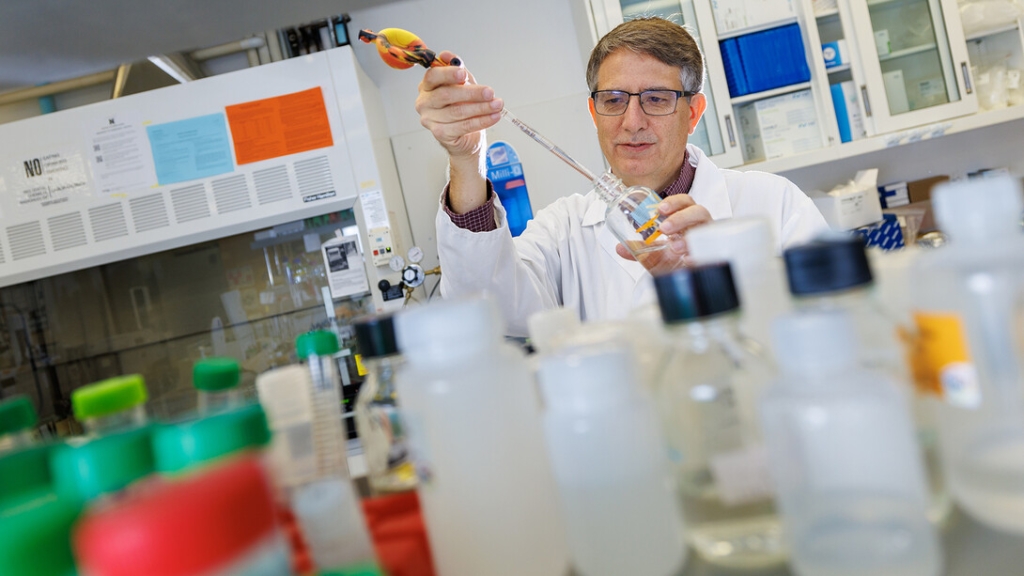
Edgar Cahoon, director of the University of Nebraska–Lincoln’s Center for Plant Science Innovation, has been elected to the National Academy of Sciences, one of the nation’s highest honors for scientists and engineers.
Cahoon is the sixth Husker faculty member elected to the academy. He is also the second affiliated with the Center for Plant Science Innovation. The academy announced the honor April 28 as part of its election of 120 new members and 25 international members.
“Dr. Cahoon’s election to the National Academy of Sciences highlights the exemplary research taking place at Nebraska,” said Interim Chancellor Katherine S. Ankerson. “His work illustrates how discoveries made here lead to solutions with lasting impacts that reach far beyond our state.”
An internationally recognized expert in plant lipid biotechnology, Cahoon’s research is helping advance biofuels, improve crop resilience and develop more nutrient-dense grains.
“Dr. Cahoon’s research is respected by plant scientists around the world,” said Jen Nelson, vice chancellor for research and innovation. “His accomplishments, both as an individual and as director of the Center for Plant Science Innovation, have strengthened UNL’s reputation as one of the best places to pursue innovative plant science research.
“Earning a place in the National Academies reflects the impact of his distinguished career.”
Tiffany Heng-Moss, NU vice president and Harlan Vice Chancellor for the Institute of Agriculture and Natural Resources, said Cahoon’s influence extends well beyond his research portfolio.
“Dr. Cahoon is an exceptional scientist whose work is advancing improved biofuels, more nutrient-dense grains and increasingly resilient crops,” Heng-Moss said. “Equally important, he is a dedicated and thoughtful mentor to both graduate and undergraduate students.
“His contributions in the lab and the classroom have a tangible impact here in Nebraska and far beyond, and his election to the National Academy of Sciences is well deserved.”
Cahoon, the George W. Holmes Professor of Biochemistry, said he was surprised when he learned of the election during a phone call from a member of the academy’s Plant, Soils and Microbial Sciences section.
“I was quite shocked but very happy to hear the news,” Cahoon said. “Soon after receiving the call, there was an impromptu Zoom meeting with current and new members of the two plant-related National Academy sections. It was exciting and a little overwhelming to see all the scientists I have long admired.”
Cahoon has published nearly 200 peer-reviewed journal articles, with his work cited more than 19,000 times. He also holds 36 patents connected to his research. His honors include an honorary doctorate from the Swedish University of Agricultural Sciences and the University of Nebraska system’s Outstanding Research and Creative Activity Award.
His interest in plant science began while growing up on his family’s farm in Virginia.
As an undergraduate at Virginia Tech, Cahoon discovered a graduate-level plant biochemistry textbook in a bookstore and quickly found his future path.
“That’s what I want to do,” he recalled thinking.
He switched his major to biochemistry and later pursued graduate studies at Cornell University and Michigan State University.
Cahoon credits mentors throughout his academic career with shaping both his scientific approach and collaborative mindset.
“At Cornell, Dan Lynch taught me about analytical chemistry and biochemistry of plant lipids,” Cahoon said. “At MSU, I worked in John Ohlrogge’s lab for my Ph.D. John was a humble person who put science before his personal gain, so he was a good example.”
He also cited John Shanklin at Brookhaven National Laboratory and UNL scientist James Van Etten as major influences.
“Jim is a great example of a scientist and a scholar,” Cahoon said.
That collaborative approach continues to shape Cahoon’s leadership at Nebraska. He joined the university in 2008, having previously worked at the Donald Danforth Plant Science Center in St. Louis.
He was selected to serve as director of the university’s Center for Plant Science Innovation in 2010. During his tenure, Cahoon has expanded the center’s national research profile while mentoring nearly 40 graduate students and postdoctoral researchers.
Currently, Cahoon is involved in two large collaborations with the U.S. Department of Energy. The Center for Advanced Biofuels and Bioproduct Innovation is a large bioenergy research center trying to engineer sorghum to make oil in its leaves and stems. Another DOE project, “Bigger, Better, Brassicaceae Biofuels and Bioproducts,” looks at how oil seeds and the mustard family make fatty acids, with the goal of making it a better feedstock for sustainable aviation fuel.
He said the academy election reflects the broader strength of plant science research at Nebraska.
“I hope the administration can use this to expand our profile in agriculture and nutrition and bring opportunities that will benefit our programs,” Cahoon said.
Cahoon’s election marks the second consecutive year a University of Nebraska–Lincoln faculty member has joined the National Academy of Sciences. Sherilyn Fritz, professor of Earth and atmospheric sciences, was elected in 2025.
Other UNL faculty members elected to the academy are Raymond Hames, anthropology, in 2020; Van Etten, plant pathology, in 2003; J.M. Daly, biochemistry, in 1984; and Myron Brakke, plant pathology, in 1974.