
Tiffany Lee, September 2, 2026
Research wins, Arthropodium success propel CAREMI forward
Arthropods are small, but they could play an outsized role in tackling some of the world’s biggest challenges.
That’s the idea behind the Community for Arthropod Research, Education, and Materials Innovation at the University of Nebraska-Lincoln. Led by Husker researchers Eileen Hebets and Angela Pannier, CAREMI is driven by a vision that arthropods – a vast group of animals that includes insects, spiders and crabs – could serve as a unifying focal point for interdisciplinary research in medicine, agriculture, materials science and more.
Launched in 2024 with a Grand Challenges Planning Grant from the Office of Research and Innovation, CAREMI’s momentum continues to grow. Earlier this year, Hebets, Pannier, Nicole Sexton and graduate student Jillian Kurovski published a paper in the journal Insects making a case for harnessing arthropods’ resilience and diversity as a source of inspiration for open-ended, transdisciplinary research.
The paper – a CAREMI “manifesto” of sorts, Hebets said – encompasses the community’s big-picture goal of facilitating unexpected connections.
“What excites me most about this paper is that it puts into words the idea that has been driving CAREMI from the beginning: arthropods can be a kind of intellectual and creative magnet,” said Hebets, George Holmes Professor of biological sciences. “They are so extraordinarily diverse, and they intersect with so many aspects of our lives, that they give people who might otherwise never find themselves in the same room a reason to come together. And once you create that community, you don’t necessarily know where the connections will lead.”
That spirit of interdisciplinary collaboration is translating to tangible research progress. About 40 Husker researchers, along with colleagues from the University of Nebraska Medical Center and other institutions within Nebraska and beyond, are currently affiliated with CAREMI. Partnerships among them have led to preliminary data, publications, grant proposal submissions and student research projects. Topics include arthropod-inspired biochemical sensors and dragonfly wing-inspired microfluidic chips; improved surveillance of tick-borne diseases in Nebraska; and investigations of spider venom’s potential for cancer treatment, among many others.
Pannier is Swarts Family Chair of Biological Systems Engineering and professor of biomedical engineering. Sexton is assistant professor of biological sciences.
Putting partnership into action
The community’s progress was on full display Aug. 19 at CAREMI’s third annual Arthropodium, a symposium showcasing arthropods’ impact on research, education, art and culture. Interim Chancellor Katherine Ankerson welcomed the attendees, noting that the group reflects the culture of collaboration that defines UNL.
“CAREMI is a model for what interdisciplinary collaboration can look like,” Ankerson said in her remarks.
Marlene Zuk, Regents Professor of ecology, evolution and behavior at the University of Minnesota Twin Cities, gave an opening lecture, “Six-legged Outsiders,” focused on the power of insects to inspire wonder and contemplation. Part of her mission, Zuk said, is to combat the pervasive fear of insects – she cited a survey finding that many people are more afraid of insects than death – and replace it with curiosity and appreciation for their diversity and complexity.
As a behavioral biologist, Zuk said she is particularly intrigued by the fact that despite lacking a human brain and chemicals in the blood that drive human emotion, insects often exhibit human-like and complex behaviors like caring for and teaching their young or navigating with precision across long distances.
“This makes us question what it is to be human,” said Zuk, whose lecture was supported by an Invited Scholar Grant from the Office of Research and Innovation.
The afternoon featured keynote speaker chef Joseph Yoon, who founded Brooklyn Bugs in 2017 with the goal of raising appreciation and awareness of edible insects and their potential to help meet the growing demand for food. Edible insects are high in protein and resource-efficient to produce, but in many Western countries, there is a psychological barrier to consuming them.
Yoon’s philosophy focuses on centering taste and experience rather than the scientific or moral rationale for eating insects.
“The science and sustainability case are real, but they’re not why anyone should take a second bite,” Yoon said. “Flavor, texture and gastronomy have to come first. If a dish isn’t genuinely better – more delicious, more interesting to eat – because of the insect in it, we won’t serve it that way.”
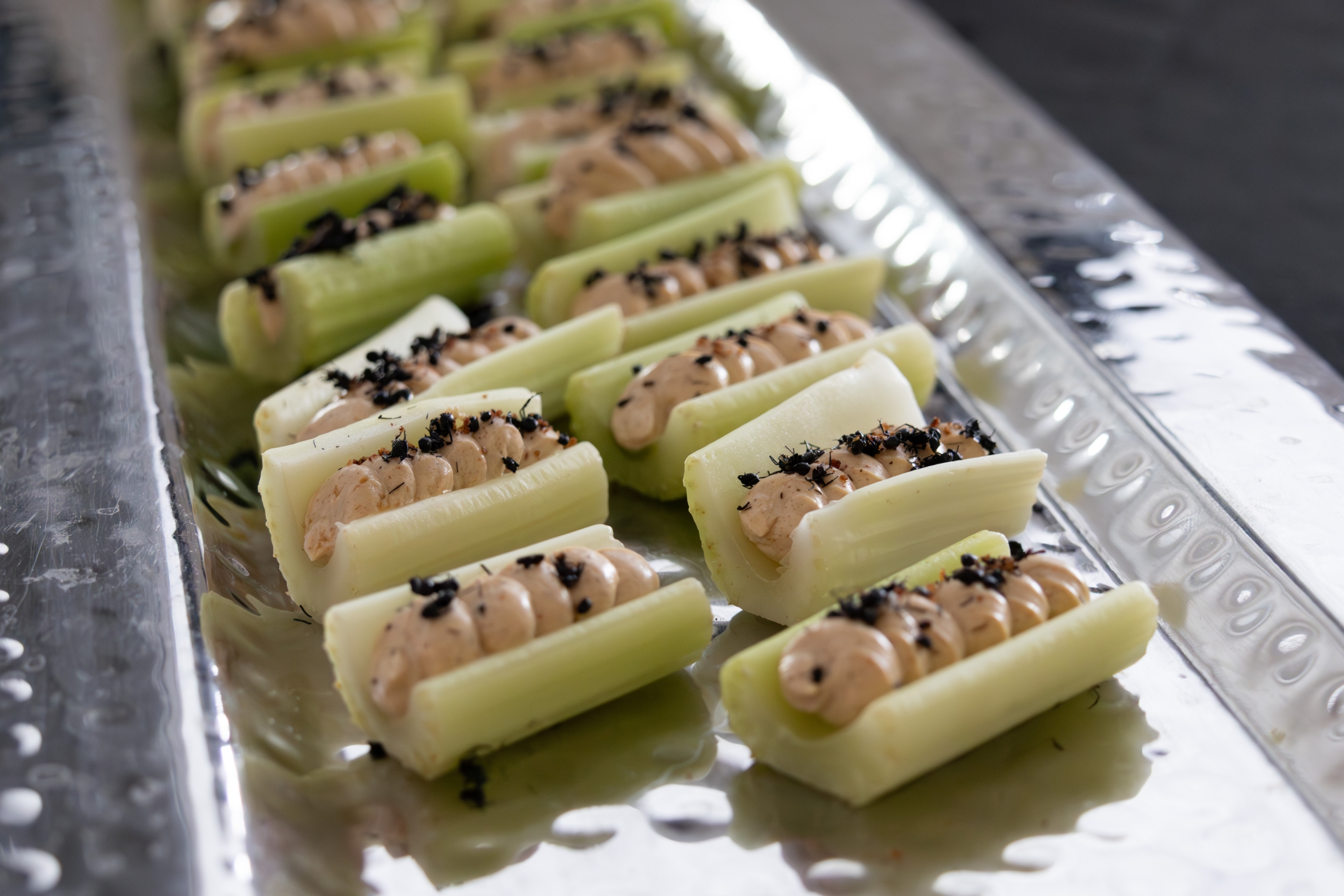
Following his talk, Yoon collaborated with UNL’s Food Innovation Center and Metro Community College’s Institute of Culinary Arts to host a Bugeater canapé party featuring appetizers incorporating edible insects, including real ants on a log, cricket and mealworm hummus, and cricket and black ant avocado toast. Chase Grove, culinary instructor at MCC and a UNL alum, said the event highlighted the power of partnership to advance the food industry.
“While the student populations at Metro’s culinary arts program and UNL’s food science and technology program are not typically interchangeable nor pipelines for enrollment into each other, the lessons to be learned from one other are extremely valuable,” he said. “Culinarians excel at teamwork, productivity and guest-centered acts of service. Scientists excel at structure, rigor and regimen.”
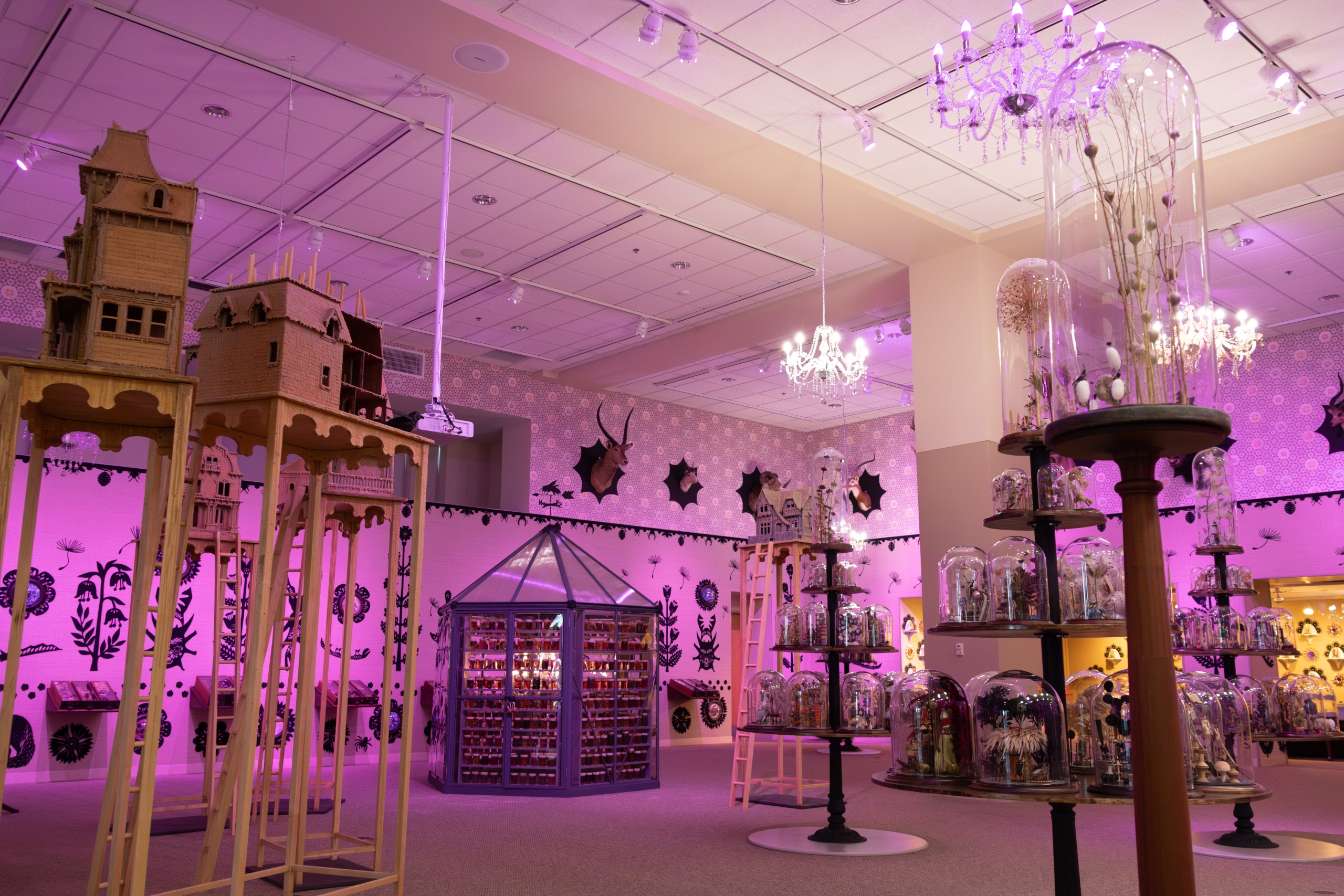
Arthropodium concluded with nearly 200 people attending the evening opening of “Jennifer Angus: Like a Moth to the Flame,” an immersive art installation at the Great Plains Art Museum. Angus, professor of design studies at the University of Wisconsin-Madison, uses insects to create patterns mimicking textiles and wallpaper. Her exhibit in Lincoln, which runs through Dec. 19, is meant to inspire wonder and curiosity about insects as well as call attention to their crucial ecological role.
Angus said that her collaborations with scientists are ultimately aimed at engaging a larger and more diverse swath of the population than is reached through academic papers or presentations. As an example of art’s impact, she points to the Smithsonian American Art Museum’s exhibition WONDER, which included her work and drew half a million viewers over six months.
“We can preach to the choir – academics and scientists – or, to effect meaningful change, we can meet people where they are,” she said.
Building for the future
The breadth and scope of Arthropodium, coupled with CAREMI’s growing research output, reflect the group’s resilience. After exhausting its initial grant funding, CAREMI has assembled a patchwork of funding sources, including donations through the University of Nebraska Foundation and internal grants and contributions from various campus units, to keep the work moving forward. The group’s long-term goal is to establish an externally funded, arthropod-focused research center at Nebraska.
“The original funding opportunity that helped catalyze CAREMI ultimately disappeared, but the community did not; instead, it grew,” Hebets said. “People kept talking, collaborating, sharing ideas and creating new things together. To me, that is one of our biggest successes.”
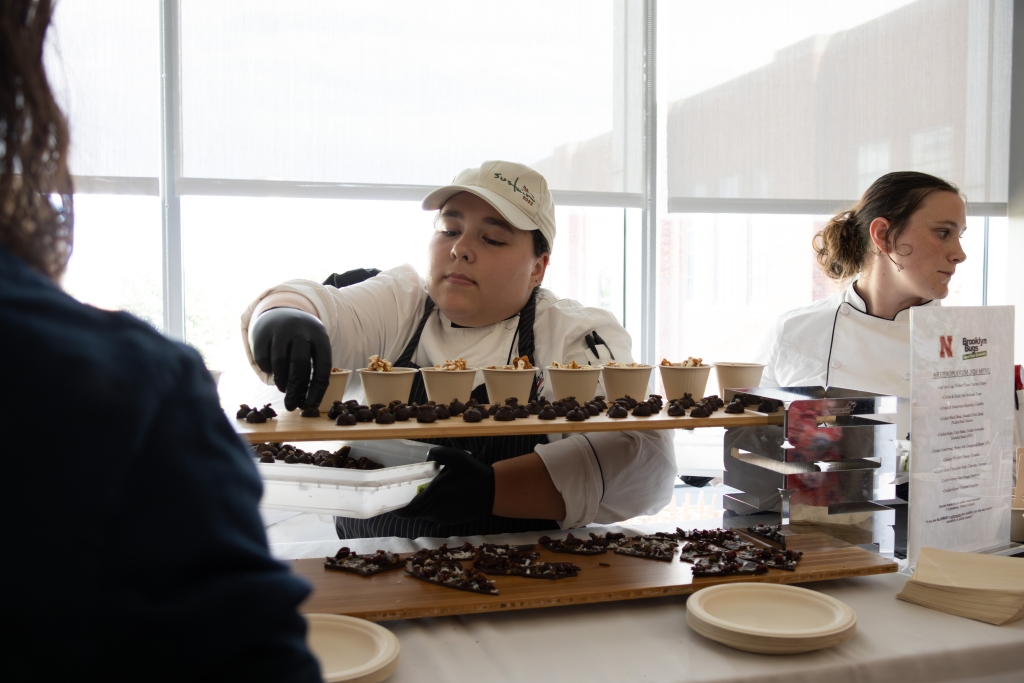
During Arthropodium, chef Joseph Yoon of Brooklyn Bugs teamed up with UNL’s Food Innovation Center and Metro Community College’s Institute of Culinary Arts to host a Bugeater canapé party featuring appetizers incorporating edible insects. Here, MCC students help serve food at the Aug. 19 reception.
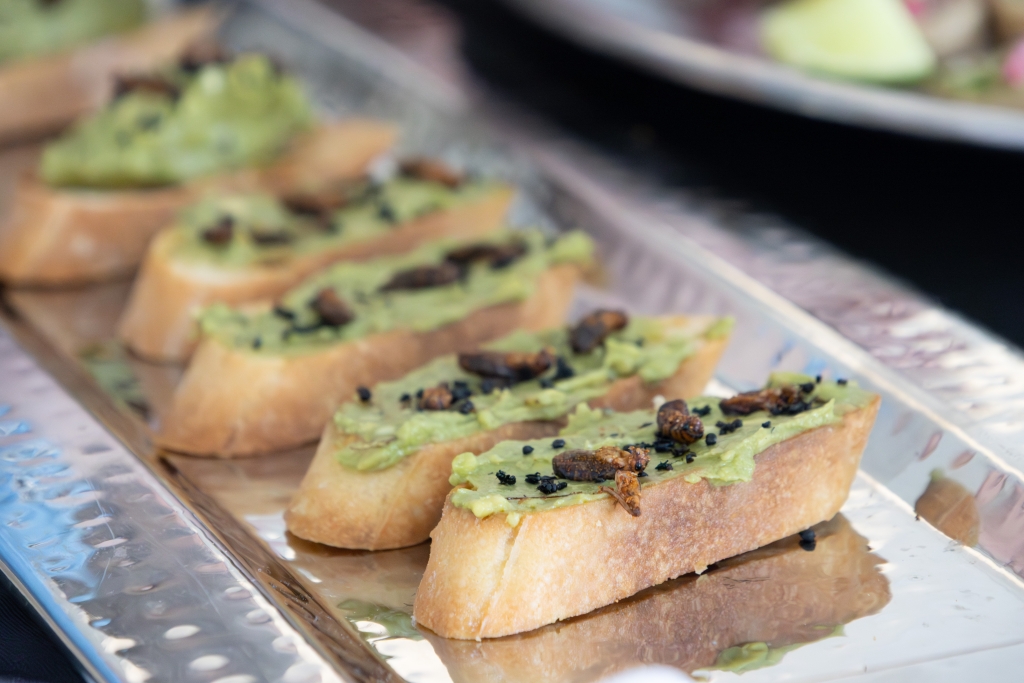
Yoon’s philosophy is that overcoming the psychological barrier to eating insects requires exceptional flavor, texture and gastronomy. Pictured here is cricket and black ant avocado toast.

Cricket honey-nut nougat bonbons were featured at the Bugeater canapé party.
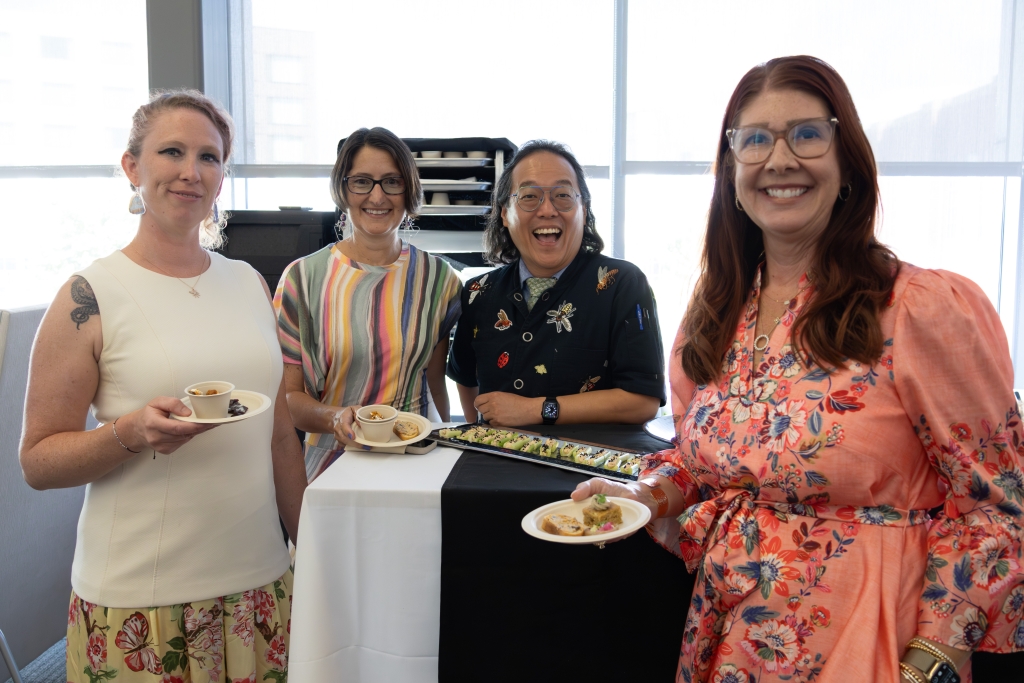
Chef Joseph Yoon of Brooklyn Bugs poses with UNL CAREMI leaders (L-R) Nicole Sexton, Eileen Hebets and Angie Pannier.
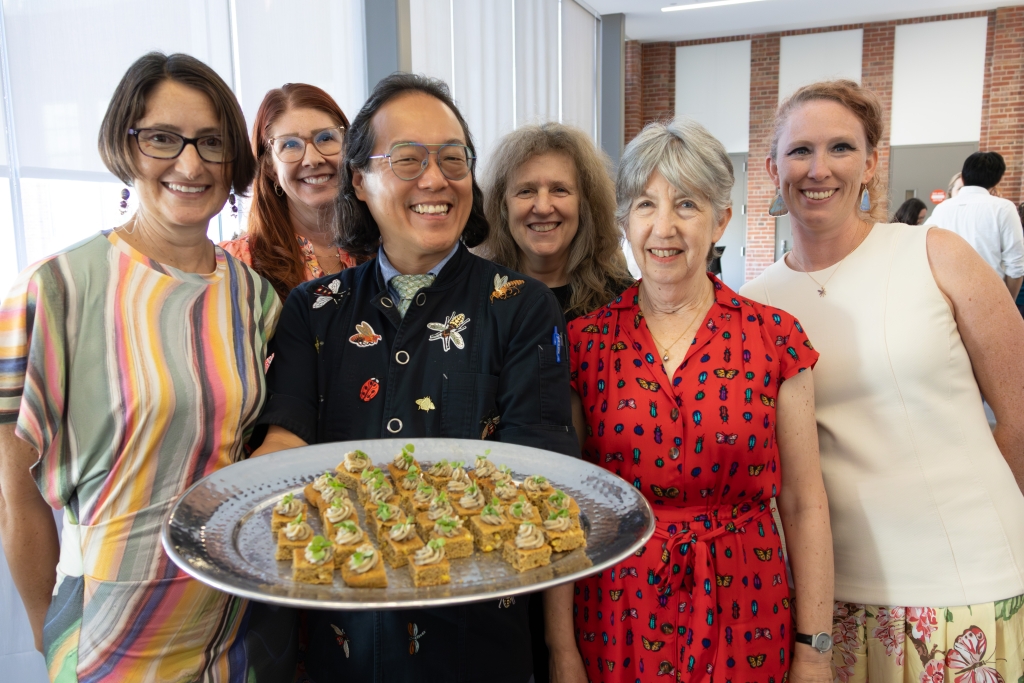
Chef Joseph Yoon of Brooklyn Bugs poses with Arthropodium organizers and guests (L-R) Eileen Hebets, Angie Pannier, Jennifer Angus of the University of Wisconsin-Madison, Marlene Zuk of the University of Minnesota Twin Cities and Nicole Sexton.
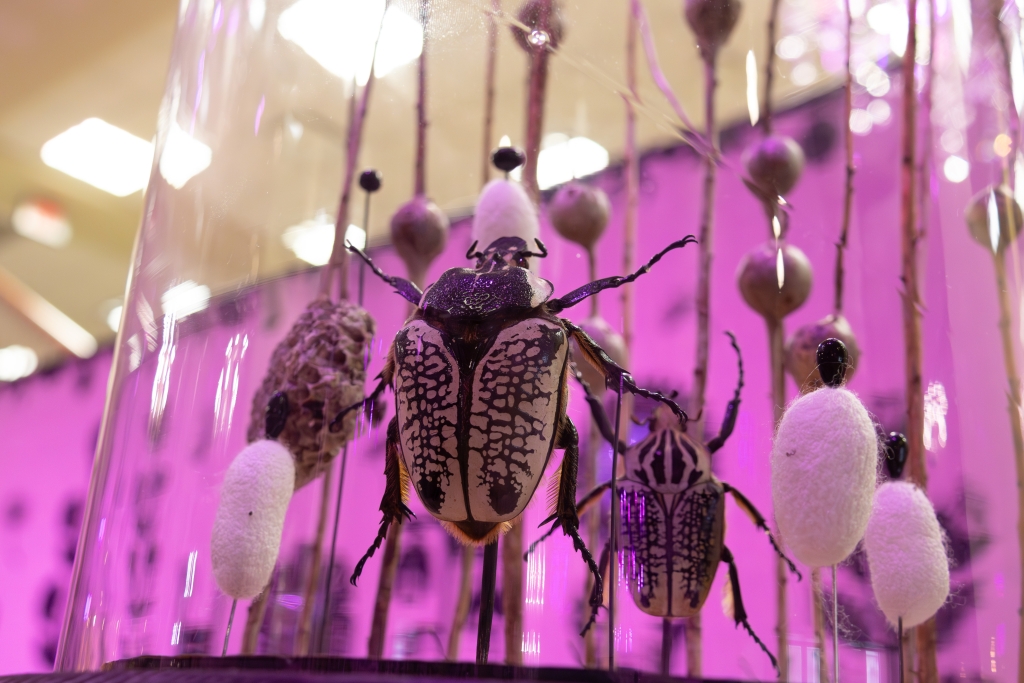
Arthropodium also featured the opening of “Jennifer Angus: Like a Moth to the Flame,” an immersive art installation at the Great Plains Art Museum. Angus uses insects to create art that inspires wonder and curiosity and calls attention to insects’ crucial ecological role. Pictured is a scene from the exhibit.
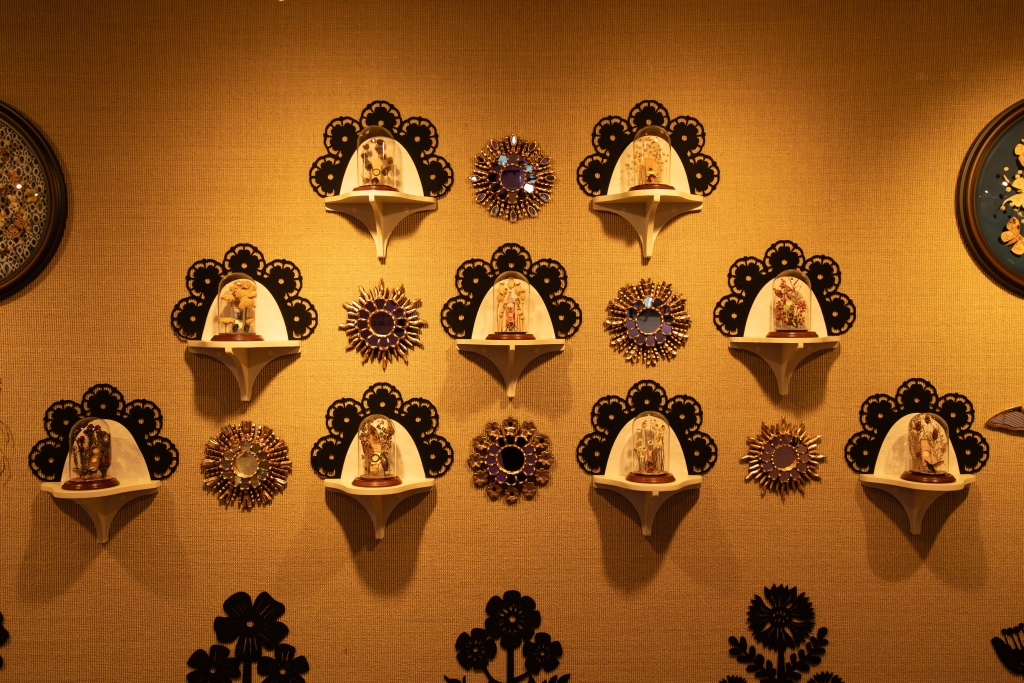
Angus uses insects to create patterns mimicking textiles and wallpaper, with the idea of drawing people into what appears to be an interior or domestic space. Angus hopes that when viewers realize the true contents of the arrangements, they will consider insects in a new light.
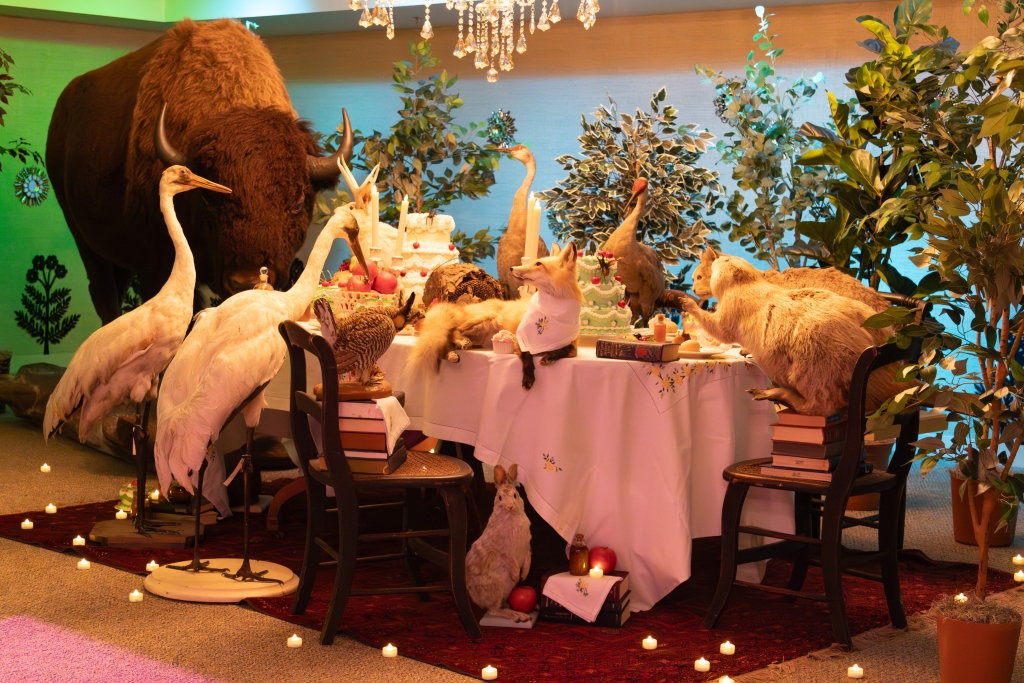
The “dinner party” scene from the exhibit highlights humanity’s relationship with the natural world. Predator and prey share a meal in a moment of civility and coexistence, opening the door for viewers to consider what would happen if humans viewed animals and the natural world as fellow participants at the table.
Angela Pannier arthropods CAREMI education and outreach Eileen Hebets insects Interdisciplinary Research Nicole Sexton