Dan Moser, April 15, 2026
UNL professor: Architecture offers unique solutions for fulfilling community housing needs
A University of Nebraska–Lincoln architecture professor is challenging long-held assumptions about the American home, proposing smaller, more flexible housing designs as a solution to affordability and community challenges.
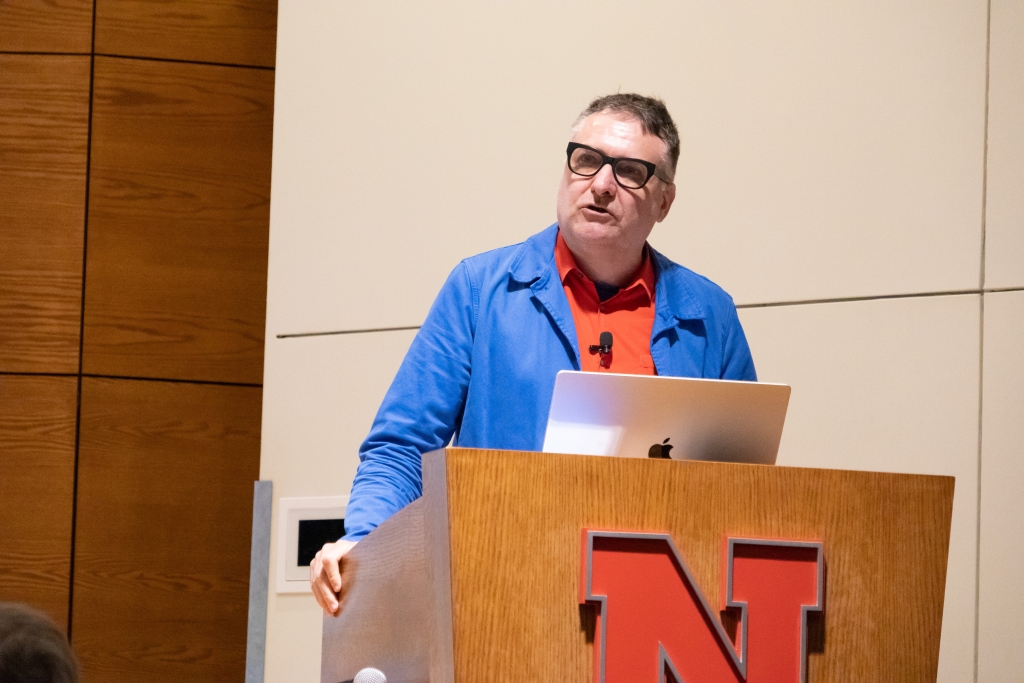
In his Nebraska Lecture April 14, Jeffrey L. Day outlined a vision that reframes housing not as static structures, but as evolving systems shaped by culture, economics and daily life.
“We believe architecture is an act, not a thing,” said Day, whose lecture was titled “House-ing,” to reflect houses as sites for testing new architectural ideas and ways of living, and also as contested realms where social conflict, access and financial inequity intersect.
While housing affordability is often framed as a financial or policy issue, he said the challenge runs deeper.
Day said there’s a misalignment between what people imagine a home to be and the realities of living together. Many Americans still aspire to single-family homes, even as cities struggle with density and cost.
Traditional multi-family housing, he noted, often fails to resonate because it obscures individual identity within large, uniform structures.
Rather than choosing between suburban sprawl and large apartment complexes, Day, through his firm, Actual Architecture Company, is focusing on what community planners call “missing middle” housing—small-scale, higher-density homes that blend into existing neighborhoods.
Projects in Omaha include compact, “aging-ready” houses designed to be accessible, affordable and adaptable. Ultimately, Day envisions a catalog of housing options that cities and residents can easily adopt, reminiscent of the Sears & Roebuck catalog of pre-fabricated houses a hundred years ago.
The first two homes, in the Benson area, are expected to be completed later this year. One already has been sold for $190,000; the other is expected to cost $150,000 to $170,000.
“The typical American house is 2,100 square feet, and the [Omaha homes] are 802 and 618 square feet. And so to achieve this, we had to think about this idea of compressing the house and fundamentally changing it to work at those small scales,” Day said.
Omaha city officials support Actual Architecture’s approach, especially its focus on infill development—building within existing neighborhoods rather than expanding outward. The two Benson homes are part of an existing neighborhood.
Day said a key feature of this approach is flexibility. Designs often include shared spaces, modular layouts and multi-use rooms that can evolve with residents’ needs.
For example, his firm is experimenting with a new duplex approach that replaces the traditional, mirrored home design with a style that allows for multiple living arrangements—multi-generational families, rental units or independent households—within the same structure.
This design approach aims to allow for change in residents’ housing needs over time, especially as they age.
Day framed this contemporary approach’s place in architectural history, where early homes in America were built to a standard width of two teams of oxen to mid-20th century experiments in prefabricated housing. Many large-scale efforts failed, he said, due to high costs, rigid systems, or a lack of adaptability.
By contrast, Day’s approach avoids proprietary systems, instead using widely available materials and construction methods to keep costs down and scalability high.
He stressed that no single approach would solve the housing crisis. Doing so will require everything from apartments to single-family homes to hybrid models.
Ultimately, the work aims to reshape how Americans think about homeownership itself, to “meet the American dream where it is.”
“If you change the idea of the house,” Day said, “you begin to change the city.”
Day, a Fellow in the American Institute of Architecture, gets his students involved in his work through UNL’s Fabrication And Construction Team (FACT), including the New Attainable House, and OurStory, a community-based project in Omaha that asks, “How do we want to live as we age?”
The Nebraska Lectures are offered twice a year and feature high-profile presentations by distinguished Husker faculty who address topics of broad interest in an engaging, accessible format. Archived videos from each lecture are available on the event website. Day’s lecture will be posted within a week.
The Nebraska Lectures: The Chancellor’s Distinguished Speaker Series is sponsored by the Office of the Chancellor, Office of Research and Innovation and Osher Lifelong Learning Institute. Speakers were selected by the UNL Research Council.