In case you missed these stories highlighting research and creative activity at the University of Nebraska-Lincoln, the Office of Research and Innovation’s communications team has compiled a roundup of some top research stories from research.unl.edu and other sources.
New facility, NSF grant advance smart building technology
Who: Xiaoqi (Clare) Liu and Iason Konstantzos, assistant professors at the Durham School of Architectural Engineering and Construction
What: Despite its unassuming appearance, the Peter Kiewit Institute’s 1,000-square-foot Human-centered Integrated Building Operations (HIBO) Laboratory may help revolutionize the next generation of sustainable and comfortable buildings. Using a three-year, $1.2 million grant from the National Science Foundation, Liu and Konstantzos will develop an artificial intelligence algorithm that blends data, knowledge and human feedback to optimize building systems for energy efficiency and occupant comfort. The team will test the tool in the HIBO Lab and aims to eventually leverage the Durham School’s network of industry partners to test in real-world commercial buildings. The algorithm, the team hopes, will be scalable, allowing for a widespread expansion of smart building technology.
“We’re figuring out what needs to happen in order to transfer this new knowledge to the real world, to places with completely different climates, building geometries, construction and people,” Konstantzos said. “I see that as a challenge, and if we are able to make a step forward in that direction, I think that would be the coolest part of this project.”
Writer: Tiffany Lee, Office of Research and Innovation
Quantum research at Nebraska boosted with $2.5 million grant
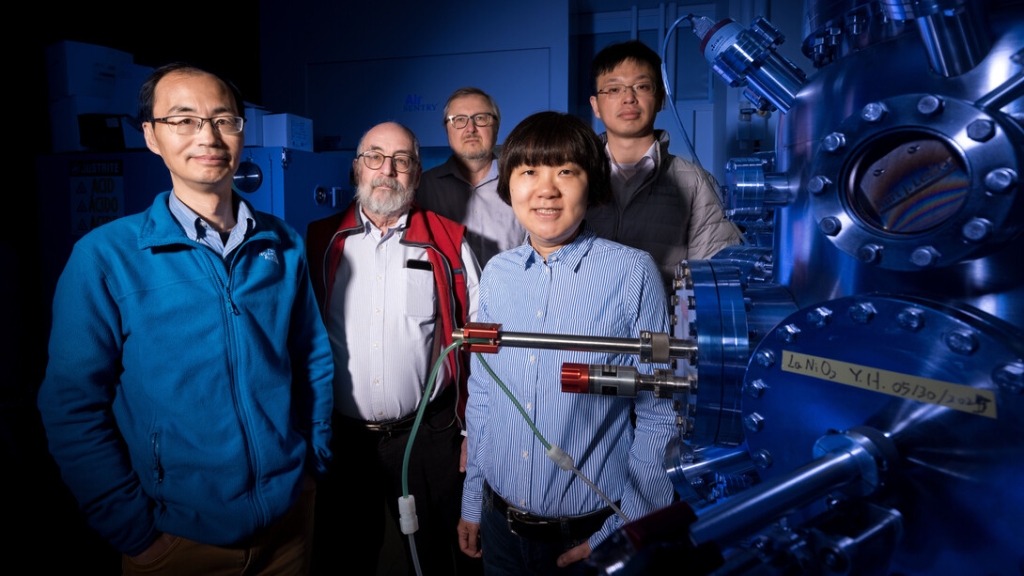
Who: Xiaoshan Xu and Xia Hong, professors of physics and astronomy; Peter Dowben, Charles Bessey Professor of physics and astronomy; Evgeny Tsymbal, George Holmes Distinguished Professor of physics; Zuocheng Zhang, assistant professor of physics and astronomy; Tula Paudel and Alexey Lipatov of the South Dakota School of Mines
What: Physicist Xia Hong leads a seven-member team that received a $2.5 million grant from the national Department of Energy’s Established Program to Stimulate Competitive Research to advance work on using ferroelectric oxides for exploring emerging quantum phases and designing more powerful and energy-efficient electronic devices. The goal is to exploit ferroelectric oxides to control oxide and van der Waals materials in novel ways, such as switching from a metal to an insulator, or from magnetic to nonmagnetic and back again. If successful, the work could lead to new platforms for smartphones and other electronic devices. The award is the third in recent months to be awarded to scientists affiliated with Nebraska’s Emergent Quantum Materials and Technologies Center, highlighting the university’s leadership in quantum materials science.
“The overarching goal is to use nanoscale control of ferroelectricity to induce a new state of matter,” Hong said. “And, in the process, foster the design of smaller and more energy-efficient devices.”
Writer: Leslie Reed, University Communication and Marketing
Nebraska-led team explores using bacteria to power artificial intelligence
Who: Sasitharan Balasubramaniam, associate professor of computing
What: With a grant from the National Science Foundation and in collaboration with Princeton University, Balasubramaniam and his team will advance their efforts to use the biological systems that initially inspired the development of artificial intelligence to create bio-hybrid computing systems that use intelligence directly from living cells. While AI systems are constructed similarly to human neural networks, Balasubramaniam believes that the network structures of bacteria, which are more resilient and easier to maintain than those of neurons, can be used in a similar way to offload work from computers onto cells. If successful, the strategy could offer myriad energy-saving possibilities that could address the growing environmental concerns associated with the widespread adoption of AI.
“I’m hoping it’s only a starting point, but that it will allow a future rethink in the way we design computers,” Balasubramaniam said. “Just think of it as like a neural network, but instead of it being on a silicon chip, it’s inside a cell.”
Writer: Victoria Grdina, School of Computing
Research team finds dinosaurs were thriving before the asteroid hit
Who: Ross Secord, associate professor of Earth and atmospheric sciences
What: A study conducted by Secord and a team of six other researchers is helping settle a decades-old scientific debate about the number of dinosaurs that were on Earth before the asteroid struck. For years, scientists questioned whether dinosaurs were already dwindling before the mass extinction because most fossils from the late-Cretaceous period come from the northern plains of North America. Secord and his team, however, were able to precisely date a fossil-rich rock layer in New Mexico, confirming it formed during the final few hundred years of the Cretaceous and was equivalent in age to dinosaur-bearing rocks in the northern Great Plains. Using ecological modeling, the team found that dinosaur communities across North America were highly diverse, stable, and regionally distinct right up until the asteroid struck – countering the idea that dinosaurs were already on the decline.
“The dinosaur fauna we dated had been known for over a century but was thought by most paleontologists to be considerably older,” Secord said. “It contained dinosaurs like Alamosaurus, a giant sauropod, that were thought to have gone extinct before the asteroid impact in the late Maastrichtian. However, it turns out they were still alive in New Mexico.”
Writer: Mike O’Connor, College of Arts and Sciences
Husker geoscientist’s innovative approach aims to safeguard irrigation canals
Who: Mohamed Khalil, assistant geoscientist with the Conservation and Survey Division and the Panhandle Research, Extension and Education Center; Matt Joeckel, director of the Conservation and Survey Division and senior associate director of the School of Natural Resources; Doug Hallum, a former university colleague now working as a hydrogeologist with the Lower Elkhorn Natural Resources District; Michael Krondak, water resources adviser with the Nebraska Public Power District
What: With a $53,184 grant from the Nebraska Public Power District, Khalil is conducting a structural analysis of the Sutherland Supply Canal, an irrigation canal that runs from Lake Ogallala to the Sutherland Reservoir in Keith and Lincoln counties. Safeguarding the structural integrity of irrigation canals is vital to the economic health of western Nebraska, where the canals have supported agricultural production since the 1890s. Khalil used a low-cost, accurate and repeatable electrical-current analysis, which involves measuring subsurface electrical resistance over time and using advanced software and computational power to highlight seepage areas. This non-invasive, time-lapse approach pinpoints water loss and structural settlement more accurately and efficiently than traditional approaches. The team published its findings in a paper of the Journal of Applied Geophysics.
“The technique has limits, but to me its applications are nearly limitless,” Joeckel said, citing the long list of possibilities for Khalil’s approach. “At this point, he’s just found the tip of the iceberg in terms of what’s doable.”
Writer: Geitner Simmons, Institute of Agriculture and Natural Resources
Husker research to focus on sorghum gene functions, regulation
Who: Chi Zhang and Bin Yu, professors of biological sciences; Edgar Cahoon, George W. Holmes University Professor of biochemistry
What: Zhang, Yu and Cahoon, who collaborate as members of the Center for Plant Science Innovation, received a three-year, $1.6 million grant from the U.S. Department of Energy to focus on the genome-wide identification of microexons to advance knowledge on gene functions and regulation for oil accumulation and stress response in sorghum. Microexons are miniscule coding elements in a gene that contain one to 15 nucleotides, the building blocks of DNA. Because they are so small and difficult to detect, microexons have been largely overlooked in plant genome research – yet changing or omitting even one nucleotide can affect phenotypic expression. The team previously developed foundational methodologies and analytical frameworks to identify and characterize microexons, which is an important building block for the next stage of their work. Project findings could enable breeding and engineering of crops that are better equipped to thrive in variable climates.
“The insights and tools developed in our earlier work provide the technical infrastructure and biological context necessary for the success of this new phase,” said Zhang, who is leading the project.
Writer: Kim Tedrow, Center for Plant Science Innovation
Getting Ready program continues to engage families, prep children for success
Who: Lisa Knoche, research professor in the Nebraska Center for Research on Children, Youth, Families and Schools and co-principal investigator of the Getting Ready program
What: The Getting Ready Program, one of the first projects launched by CYFS, has promoted healthy development for children aged 5 and younger for more than two decades. The program brings evidence-based parent engagement strategies to early childhood programs throughout Nebraska, to this point benefiting more than 6,000 children and their parents and 500 educators across Nebraska and the Midwest. Preschool children who participated demonstrated enhanced skills in managing emotions and behavior and developing sustained relationships, as well as language and early reading skills that were better than 80% of their peers. Developed at UNL, Getting Ready recently received national recognition as a “featured program” in Family Engagement Solutions, an initiative of the National Parent Teacher Association’s Center for Family Engagement. The platform delivers evidence-based family engagement programs to educators, administrators and advocates.
“Initially, when you’re establishing the evidence, you’re just a research team,” Knoche said. “Getting Ready is now recognized by the early childhood community in Nebraska, and people understand how it can positively impact their programs and families served.”
Writer: Chuck Green, Center for Research on Children, Youth, Families and Schools