Core Facility News News for Researchers
Posted July 2, 2026 by Dan Moser
This is the fifth story in a series featuring UNL’s research core facilities and their capabilities.
Cryo-electron microscopy capabilities help scientists at the University of Nebraska-Lincoln understand molecular foundations and bolster the university’s expertise in biomedical and agricultural sciences.
Or, as Husker biochemist Eduardo Romero Camacho puts it: “We’re trying to understand how the building blocks of life work.”
The technology does so by revealing the hidden structure of life in near-atomic detail, advancing work in disease research, drug development and fundamental biology.
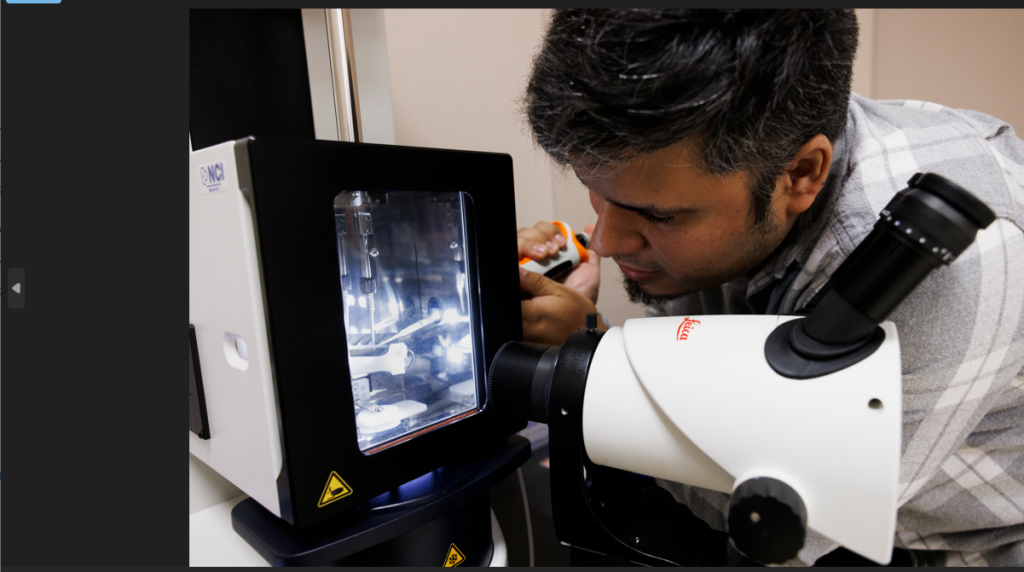
Romero, research assistant professor, is the director of the CryoEM Core Facility, which houses this imaging technology. It is the only facility of its kind in Nebraska and, in fact, one of only a few nationwide.
Cryo-electron microscopy – cryo-EM for short – allows scientists to visualize proteins, nucleic acids and even small cellular components in their natural state. Unlike other methods that require crystallizing samples, cryo-EM preserves biological molecules in a frozen, water-rich environment—providing a more accurate picture of how they function.
In the core facility’s two years of existence at UNL, 38 faculty, several industry partners and institutions including the University of Kansas Medical Center, the University of Iowa and Iowa State University have used the technology to advance their research, Romero said.
The facility also partners with the University of Nebraska Medical Center, including analysis of biomolecules involved in diverse viral pathways such as those in the herpes simplex virus.
Cryo-EM works by rapidly freezing samples into ultra-thin layers—less than 200 nanometers thick—and imaging them with an electron microscope. Scientists then process the resulting data to reconstruct detailed 3D maps of molecules, often at near-atomic resolution.
The facility, part of the Nebraska Center for Biotechnology and supported by user fees, provides end-to-end support for researchers, from preparing samples and operating sophisticated microscopes to training students and analyzing data. Romero said the training piece is key in preparing graduate students, postdoctoral researchers and undergraduates to build expertise for a rapidly evolving field.
Looking ahead, the facility aims to expand its capabilities by acquiring additional instrumentation that would allow researchers to study biological structures directly within cells. Such advances could enable scientists to pinpoint where viruses or proteins are located inside cells, offering deeper insights into how diseases develop and spread.
Before he came to UNL, Romero managed a similar facility in Colorado.
“Cryo-EM gives us a better picture of biology as it really is,” he said. “And that’s essential if we want to solve complex problems in health and science.”