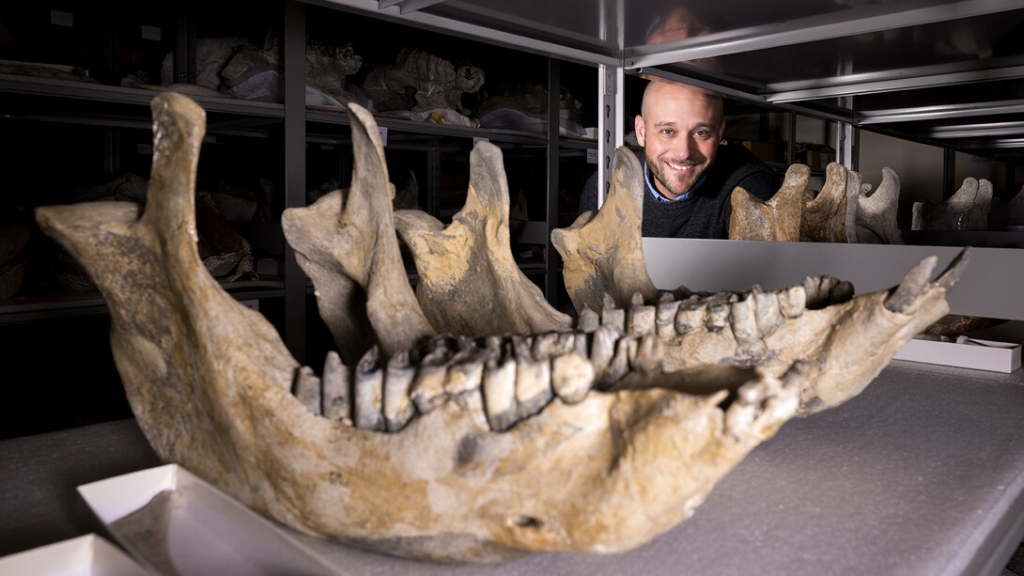
University of Nebraska State Museum
Troy Fedderson, June 22, 2026
Poust helps identify new species of feathered dinosaur
Field course set researcher on path to paleontology career
Ashley Poust’s path to discovering a new species of feathered dinosaur began with a class he never expected to enjoy.
Looking to satisfy a science requirement as an undergraduate, Poust signed up for a geology course that would let him live and learn in the Rocky Mountains for a few weeks in the summer. The experience was the first step in a paleontology career that has taken him from Montana to China and onto an international team that has identified a previously unknown dinosaur species.
Today, at the University of Nebraska–Lincoln, Poust is helping Huskers find their own unexpected paths into science.
This summer, that means taking graduate students into Montana to search for dinosaur fossils and mentoring an undergraduate researcher joining a project in Paraguay studying how fossils form, decay and enter the geologic record. The goal is less about replicating his experience and more about widening access to the kinds of opportunities that can redirect a career.
“You can’t always know what experiences you accumulate or the people you meet are going to mean for your future,” said Poust, Poust, Dr. Michael and Jane Voorhies Endowed Curator of Vertebrate Paleontology at the University of Nebraska State Museum. “If you’re too focused on one path, sometimes you miss opportunities that might benefit you in the long run.”
Conversation that changed everything
One of those moments came more than a decade ago at a scientific conference.
Poust was then a graduate student at Montana State University studying small, feathered dinosaurs related to the origin of birds. At a Society of Vertebrate Paleontology meeting, he attended a talk on a fossil discovered in China’s Changma Basin — a site known for exceptionally preserved Early Cretaceous birds and other delicate fossils.
Most in the audience saw fragments of a skeleton preserved in stone. Poust saw something familiar.
“I saw this and thought, ‘That’s almost the same as the thing that I had been studying, only larger,’” he said.
After the talk, he introduced himself to the presenter, Matt Lamanna. That conversation led to a collaboration involving researchers from the Carnegie Museum of Natural History, Chicago’s Field Museum and colleagues in China working at the Changma fossil site in Gansu Province.
The specimen itself was only partially preserved — a fragment of a shoulder and forelimb locked in stone — but it carried enough detail to warrant a closer look. Poust contributed comparative anatomy work and helped refine interpretations of the fossil’s growth and preservation, work that was essential in determining what features were real and what had been altered by crushing over time.
He also helped conduct the phylogenetic analysis, the large-scale comparison of hundreds of anatomical traits used to determine evolutionary relationships among dinosaurs and early birds.
“It’s really a hypothesis,” Poust said. “You build it on the best available data, and then it gets tested every time a new fossil is found.”
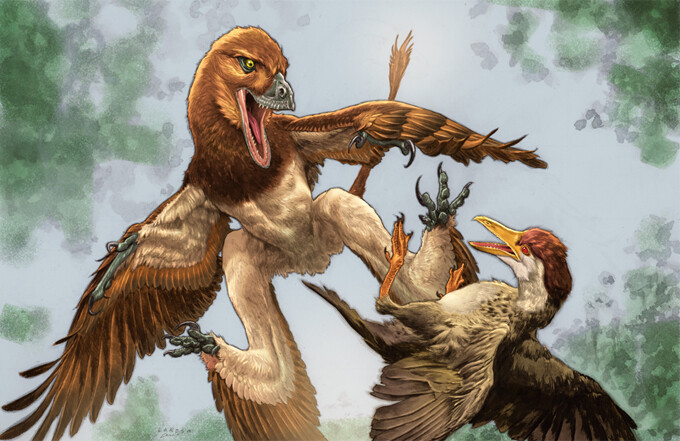
Over time, the team’s analysis placed the specimen within a group of small, feathered, bird-like dinosaurs known as microraptorines — close relatives on the evolutionary branch leading toward modern birds.
Eventually, the team determined they were looking at something entirely new: a previously undescribed species they named Jian changmaensis.
But that conclusion took years of restraint and repetition, as the team carefully considered the details in what they started calling, “the arm.”
“You don’t want to assume something is new just because it’s interesting,” Poust said. “You have to let the evidence take you there.”
Building opportunities in Nebraska
At Nebraska, Poust is focused on carrying that same approach into the next generation of researchers — not just in terms of method, but access.
His work now spans field sites in the United States and collaborative research in South America, including projects aimed at understanding how fossil environments differ and why some settings preserve entire ancient ecosystems while others leave only fragments behind.
That work feeds directly into student experiences. This summer’s Montana fieldwork will give graduate students hands-on experience in fossil recovery and identification, while the Paraguay project will expose an undergraduate researcher to international collaboration and modern ecosystem research tied to ancient environments.
“These are the kinds of experiences that change how students see science,” he said. “They’re not just reading about fossils — they’re part of the process of finding and interpreting them.”
For Poust, that access is central to the mission of the University of Nebraska State Museum.
“It’s not just about having collections,” he said. “It’s about using them to train students, build skills and connect Nebraska to research happening around the world.”
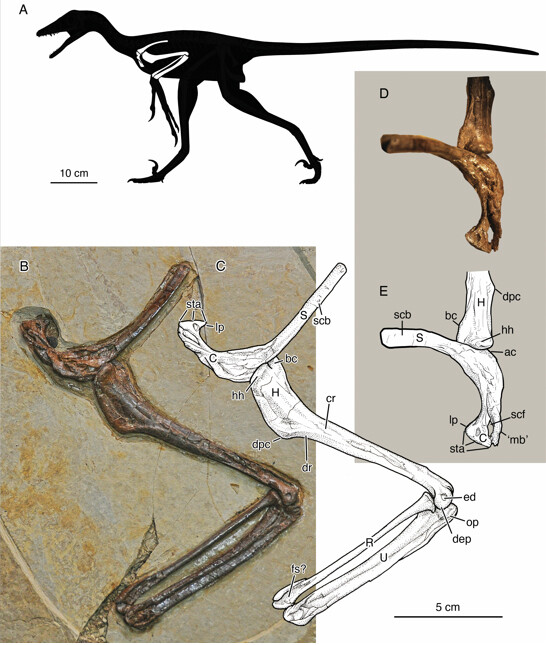
The holotype fossil of Jian changmaensis, a newly identified species of feathered dinosaur, includes parts of the shoulder and forelimb preserved in rock from China’s Changma Basin. The specimen, shown alongside interpretive drawings highlighting key skeletal features, was described by an international research team that included University of Nebraska–Lincoln paleontologist Ashley Poust.
Small fossil with a larger story
The discovery of Jian changmaensis adds to a growing body of evidence from the Early Cretaceous that is reshaping how scientists understand the evolution of birds and flight.
Microraptorines — the group Jian belongs to — are especially important because they blur the boundary between birds and non-avian dinosaurs. Their anatomy preserves a mix of traits that emerged gradually over time rather than in a single evolutionary step.
Related species show feathers on both arms and legs, along with evidence of varied diets that included small mammals, birds and fish, suggesting these animals occupied flexible ecological roles in ancient ecosystems.
“I keep comparing them to foxes,” Poust said. “I think they were probably relatively generalists — flexible, opportunistic predators with a broad diet.”
While questions remain about how Jian changmaensis lived and moved through its environment, its anatomy adds another data point to an ongoing scientific conversation about how flight-related features evolved.
For Poust, that is where the work remains most compelling.
“This is just one tiny piece of a much larger puzzle,” he said. “But it is helping us move toward a complete picture.”